Showing posts with label novel writing. Show all posts

Monday, November 2, 2015

Bring out your WIP!

It's NaNoWriMo time again. I am rewriting a novel whose first draft I started in April's NaNoWriMo and finished sometime around Midsummer. While there were definitely elements in there I really liked, the plot ended up being kind of a mess, the characters being illogical, and the settings unsatisfying. So pretty much everything goes into the rewrite bin and NaNoWriMo is perfect to help with getting that done!

All this being said, here is the first page or so of my second seriously written novel, The Avatar Legacy.

---

The sight of the corpse told Miki Kim that it was time to leave home. Again.

Victoria Bleedwell wasn’t the first corpse Miki had seen, nor was she even the first corpse of a friend and crewmate. Victoria’s wasn’t even the worst she’d seen. But as she stepped fully into the chill of the medical bay currently housing Victoria’s body Miki promised herself that Victoria’s would be the last corpse she would ever see.

Victoria’s nanocolony swarmed over her body, visibly making the remainders of her clothes shift. They were looking for something to fix, just as their programming directed them to. There was nothing wrong with Victoria anymore. Beyond her being dead.

Miki cupped Victoria’s cheek.

“I’m sorry,” she said.

She half expected Victoria to grin and wink at her like she had so many times. When nothing happened, Miki took her hand away and squeezed it into a fist. No room for sentimentality. Not in this life, or this home.

She walked around the table, keeping her eyes off the body. She pushed a wall cabinet open and grabbed a habitat container. She turned to another cabinet and added some feed into the habitat before turning back to the body to coax the colony inside the habitat. They would need to be fed by something and Victoria was no longer producing new skin cells to create dead ones. Miki had once seen what a colony could do to a body when left to sit too long and she wasn’t eager to try that again.

The colony moved into the habitat in waves and soon Miki had to brace the container against the operation table to make sure she didn’t drop it. The colonies always weighed more than she expected them to.

Once no more visible waves were forthcoming, Miki took the container away and sealed it. It would automatically maintain a suitable environment to keep the colony relatively active while also lowering their mobility to the point that they wouldn’t burn out before they were applied to someone else.

Monday, April 20, 2015

Research agents to query your little heart out

I don't care how special your book is, have the courtesy to follow the guidlines.While I have never gone from polished to published I am currently in the process of querying my first novel. Well, not really my first but the first that I consider even close to being good enough to query.

Here's the mini-synopsis:

Layla Ballard is just a succubus trying to stay on the straight and narrow in the human world – a feat that would be easier if she hadn't just killed her boss. To hide the murder/snack, and keep cash coming in until she can figure out what to do next, she takes over his P.I. firm, only to catch a case that’s far beyond their usual “cheating spouses” client. In trying to find a missing sister, Layla discovers a slew of disappearances and deaths that point to a culprit that isn't human. Between dodging a murder charge and battling her hunger, can Layla get it together in time to save the sister and stop the supernatural murderer?

It's been quite a journey from first draft to the query pile. I've written before about my experience with coaching. After all of my editing rounds were complete, I sent my initial query draft to Cathy who punched it up quite a lot. Since Sheena already wrote an excellent post about the query process in general, I'm going to focus on one part in particular: researching your prospective agents.

Know what they want part 1

First comes the easy part. Well the super easy part, I should say. Find out what they want. I'm not talking about the genres or anything like that yet. Find out the submission guidelines. If your agent wants the first five pages and a one-page synopsis don't send the first three chapters and a blow by blow outline.

Know what they want part 2

The second step is finding out what they're actually looking for. This is so you're not going to send a serial killer killer trailer for someone who's looking for a sweet romance or science-fiction hard science fiction to someone who's doesn't rep anything speculative. This is also a good point to check that there they actually represent something that is like the thing that you have written. So say for example if you if you write sweet romance and the agent is looking for erotic romance or, say, you write hard science fiction and the agent is looking for space opera you don't waste your time or theirs sending them something that they're just going to reject out of hand.

The reason I'm putting this second is that this can get quite detailed. While you're doing this, you should also have an eye toward the next step, which is:

Make sure you know why you want them

Now there are some agents who just don't care. QueryShark has mentioned several times that she's not interested in any greetings somesuch and that she wants you to start with your book. Most agents are not like that. Many are quite adamant about getting to know the reason you are querying them specifically and not the agent down the street. Even if you are also querying the agent down the street.

Even if you are querying the QueryShark or to be more specific Janet Reid, it's still a good idea to have a clear reason for your own purposes why you want to query that particular agent. An agent doesn't have to be a bad agent to be unsuitable for you specifically. 


Make sure you know how long it takes them to respond

This is more for your own piece of mind than anything else. Most agents can take up to eight weeks to respond and others never do. You should of course track your queries and make sure you know who you've queried, when, and what kind of response, if any, you've received. I prefer QueryTracker myself but there are certainly other ways of doing this, starting from a single CSV format text file.

Most importantly, have fun. The world will not end even if you don't get an agent for this project. It won't even necessarily halt your literary career. There are still plenty of options out there. Meanwhile, as you wait, you should be writing the next book. Preferably in another world.

Saturday, November 15, 2014

Work in Progress - Karen

Oy, have you missed me? I've missed me, have you seen my October and first half of November? Shoot. Me neither. Nor has my nanowrimo project seen me…I'm a few…thousand words behind, alas.

But have no fear, I'm here now, and I have WORDS to SHARE!

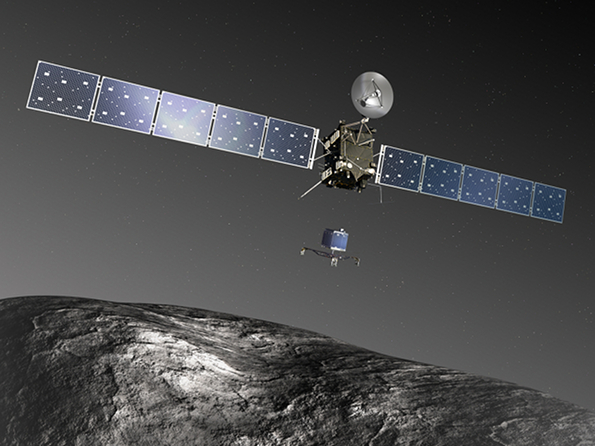
And what a week in which to share them! This week, humans have landed a SPACE SHIP on a COMET! Are we awesome or what? I love it when I'm writing science fiction and the scientists go off and make science fact. Best part of this job. The Philae is now sleeping, as it unfortunately bounce-landed into a spot that makes it difficult to charge its batteries, but I predict this isn't the last we'll hear of the little lander, nor its orbiter, Rosetta. Cool stuff.

I'm working on a sequel to my 2009 Nanowrimo project ('09 project is called A Star to Lead Me.) This year's project is called Guide Me Through the Deepspace Night. (Ridiculous side note: This is a trilogy, the three titles make a haiku. I'm a word nerd. I changed the title of this project this month and had to keep it 7 syllables. You'd be surprised at how many 6 and 8 syllable book titles you can come up with when trying to find a 7 syllable one.)

I'm slow this November because I've been overtaken by events (World Fantasy 14 in D.C. last weekend, the kids' school's book fair all last week. Lots of books to sell! Always interesting to be a bookseller for a week and see what people are interested in, what they buy.)

And now I'm trying to get back into the habit. Funny how difficult it can be to get into a writing habit when you're not in a daily routine. I have talked before about how I'm a burst writer versus a daily writer, something that's a little different than what you'll hear many writers spout as the One True Thing About Being A Writer (the whole "write every day" business) -- but yet there is some wisdom to that thing!

I'm really quite certain most of Guide Me is pretty terrible at the moment, but here's a bit from the story as-is. Quick plot recap/summary: Brynne is on a colony spaceship headed for the Gliese 876 system with 6000 of her close personal friends (not.) When her ship enters the solar system orbiting the Gliese star, all the adults and anyone thirteen and over on the spaceship falls into a mysterious sleep. Brynne and the other kids have to figure out how to operate the ship and keep chaos from descending, oh and while they're at it they should probably figure out what that unknown energy signature making a beeline for them is. Aliens? Brynne's going to have to figure it out and soon - her thirteenth birthday is in a couple of days!

In this scene, Brynne has been talking to Hunter and Sampriti, two friends who are spearheading the work on the ship's navigation systems:

“And a pilot?” Brynne asked. 
“Yeah, we’ve got … where is she?” Sampriti said, looking around the room, her eyes finally resting on the girl laying on her back on the table. “Oh, there she is. Halley. Named after a comet and now she’s going to have a chance to pilot us out of this mess. She’ll work the engine burn. We’ve run,” she sent a wry look in Hunter’s direction, “dozens of scenarios and her reflexes are fastest and she’s got most of the equations in her head already.”
Brynne looked back at the girl, still gazing at the ceiling. Upon reflection, Brynne realized that perhaps rather than staring at the shadows of her fingers, perhaps the girl was drawing ship trajectories in the air. But she looked so young. Before she could vocalize the thought, though, Brynne squashed it. The girl doubtless was young, as were all of them. Age ceased to matter when the stakes were life or death. Either burn the ship’s engines in the right manner and sequence to change the Selenium’s trajectory, or meet certain doom in the debris field or planet atmo of the gas giant they were current pointed at. 


Saturday, June 28, 2014

A sense of place

It's almost the eve of our summer vacation, which this year is a trip to France and Belgium, including bucket-list items like staying on Mont-Saint-Michel. Not familiar? It's this place:


Yeah. This place. Swoon. 

And it got me thinking about all the ways that *place* matters in fiction. It was at a Dean Wesley Smith workshop where I first learned that "setting is the opinion of a character." Meaning, the setting that your characters are in can be reflected through the way they think about the place. Not just objective facts, but the subjective reality of each character's thoughts and opinions about where they are. 

This lesson was really driven home to me in a class I took with Mary Robinette Kowal (awesome classes, Dean's too, highly recommend if you can swing it. Both offer online classes.) Mary had us do one exercise of just free-write describing the room we were in. No rules, just writing. THEN after that free-write period was over, she had us go back and free-write the description of the room *from the perspective of a firefighter.* Different room, entirely. No more about the color and subtle lighting or the contents of the bookshelves. Instead it was points of entry/exit, flash points of flammables (all those books!) It was a fascinating exercise and one I encourage you to do. It may be the standard fare of creative writing classes in college, but I never took a creative writing class in college, I came to writing later in life. I needed the lesson! 

So places in fiction matter quite a lot. And the way our characters think about them is a great way for us to introduce aspects of character to the reader. I often make it hard for myself. Much of my books are set in space, mostly aboard spaceships and space stations. I can't easily weave in natural details of the foothills when I'm talking about a spaceship the size of a school bus. But again, the setting is the opinion of the character. Here's a bit from my novel CONVERGENCE, which is coming out in paperback this summer! 

Anya watched each person slip through the membrane, their bodies disappearing through the opaque barrier bit by bit, first a foot, a leg, one arm, a torso, last the trailing arm and wisps of hair. They membrane swallowed each person whole, like the belly of a jellyfish. Anya stifled a shudder. It would be her turn soon enough. 
Her parents went next. "Bowden, Madeline. Bowden, Zach," the door hushed. 
Swallowing, Anya prepared to go through. She eyed the membrane warily, wondering if it was all just a ruse and if she was going to find herself swallowed whole by some gigantic space-beast. She hoped the digestive enzymes would kill her quickly. She sighed and stepped up as the last of her dad's brown hair disappeared. 
Hopefully one of the things conveyed by this bit of description is Anya's overall wariness about the space station (the membrane is between the transport ship she arrived on and the space station proper.) Earlier paragraphs included much teen pouty-ness about being dragged off-planet to live on a space station. Poor kid, you feel for her already, don't you? :)

How have you woven a sense of place into your fiction? How do you find the characters illuminating aspects of their character by showing how they feel about their setting?

Wednesday, May 21, 2014

The 90-Day Novel and Writer Know Thyself

I told you I'd be giving you an update on the 90- day novel project. News is mixed. I like the discovery and story-telling philosophies in Alan Watt's 90-Day Novel, but the pace of the exercises isn't working for me. The first couple of weeks are spent on getting to know the character in depth. The idea is fine, but for me, a week of that is more than enough. Even now, heading into the third week, the bulk of the exercises revolve around character and the surface of plot is just being scratched.

Don't get me wrong, I believe character is important and I understand that it's the character's motivations and desires that drive the plot, but to dwell there forever isn't preparing me to write the type of story I want to write. In many ways, Watt's method seems to be leading people into to being good pantsers. (A pantser is someone who dives into their writing with little planning, preferring to figure the story out as they go along – by the seat of their pants.)

Truth is, the method of the book and my style of writing just don't mesh. By this point in the process, I prefer to know where I'm headed and should be developing a solid plan to get there. Otherwise, I lose momentum. Right now, I feel like I've lost the voice, the attitude, of the story. It won't be too hard to regain but I need to change course now or this project will end up dead in the water. I will continue to read Watt's book for his ideas on storytelling, but I will be switching back to my own method for plotting.

This is where understanding yourself as a writer becomes important. You'll read tips on how to do things and some of them will even come from your favorite authors; it's great to try those things, but don't get discouraged if they don't work for you. Know that your path and your method will be yours alone, and that's okay. That's the way it should be. That is what will make you the unique writer you are destined to be.

If you're so new to writing that you don't have your own method, take a look at your work habits. Do you like to plan your tasks, or do them on a whim? Do you like to tackle jobs in big chunks of time, or spread out in little bits? What time of day do you work best? Consider these things when you're planning out your time to write and when you're creating your goals. If you only have an hour to write each morning, don't be disappointed if you don't get to 2000 words every day. Be realistic and cut yourself some slack.

That's one element I like about the Watt book. It's very low pressure. He keeps reminding you that there are no mistakes at this stage – it's all discovery. That keeps the fear out of writing and that's a good thing. Your first draft should be fearless, which is actually very hard to achieve. Our over-thinking brains and social conditioning tend to get in the way. Any method that can reduce fear is fine by me.

So for as much as I'm veering away from the exercises in the book, it has still taught me a lot and I expect it will continue to do so. It's been a good exploration, and I'm sure the method works great for some people. In the end, I encourage you to try new things but remember to always be true to yourself.

Wednesday, May 7, 2014

Writing a Novel in 90 Days

I lost a month. April disappeared, acted like it never happened. One minute it was Fool's day, the next, it was May Day. Sheesh.

"How do you lose a whole month?" you ask.

Well, I started a story in March that turned into a 16,000 word novelette. And because I was in a bit of a slump, I committed myself to finishing this monster piece no matter what. I continued on, even knowing there will be very few markets to send it to. And then suddenly I realized that Taos Toolbox is only two months away. This advanced workshop I will be attending focuses on novels and I want to walk in with a project in progress. Crumbs. I'd better get to work.

Enter, The 90-Day Novel by Alan Watt.

This book takes you from the humblest beginnings of an idea to a finished first draft in 90 days. You know what almost sounds crazy? You don't start actually writing your first draft until Day 29. Impossible? I don't think so. The first part of the process is all about exploring your characters and story in a loose, free-write style with no pressure. There's a big emphasis on 'holing your story loosely' so that it has a chance to evolve and grow. This actually makes a lot of sense and can prevent you from launching into a story you're not ready to write. I am currently on Day 6 and I will give you my impressions so far. In future posts, I will include an update on my progress so you can see how this unfolds. This is going to be an interesting experiment.

My project: A hard-boiled science fiction mystery set on a planet far, far away. At the beginning of this, I have a 700-word scene introducing the crime. Nothing more.

The first couple of days were fun and easy. Writing didn't feel like work at all. Since I knew this was just an exploration, I got a notebook and a pen and dove in. I don't expect any of this material to make it directly to the page or I would work on the computer. I hate typing from hand-written material. I find a nice bit of freedom working like this. It's a method I can easily see myself applying in the future to help loosen my brain.

By Day 4, I noticed some things I liked and some I didn't. I like the low pressure approach. With every exercise Watt makes sure you know that none of what you're writing is committed in stone and encourages you to explore different facets of your story. This is good. The down side is that a number of the questions presented in the exercises to explore character are rather repetitive. You know, like those personality tests that ask the same question in different ways to see how you respond. I found this a little tedious and if it continues to happen, I will probably start skipping the repetitious questions.

One other thing that is not really a down side but something to note is that the book is geared toward new writers. There are recommendations about how long you should spend on the process and other didactic remarks that a writer who knows their abilities can adjust and work at their own pace.

If you write science fiction or fantasy, I've been warned that little time is left for world building. I'll need to either do my world building separately, alongside the book's exercises, or I will have to allow more days than the 90-day program suggests. Also, I'm expecting this novel to fall in the 60-85k range, but if I were writing an epic 120k monster, I might expect to take more than 90 days. I see both of these solutions as acceptable while staying within the concept of the book. Ninety days is an ideal, not a deadline.

On Day 6 I was supposed to write a one to two paragraph synopsis of my story. I wrote two pages and plan to write more tomorrow. My justification is that my story is a mystery and it requires more plotting than some novels. I had to figure out who the villain is and what his motivations are before I can go much further. Also, this is my first time writing a mystery and I'm very concerned about plotting and creating a good puzzle. The character generation that Watt's book is taking me through this first week is something that comes natural to me and I've been hankering to get into the meat of things.

That leads me to my current feeling about The 90-Day Novel. It's a good concept and well executed. If you're new to novel writing I would suggest following the program pretty closely because I think it takes you through a lot of important steps. If you're a more experienced writer I still think this is a good program, but feel free to deviate from it as needed to suit your style and your story's needs.

If all goes well I will be walking into Taos Toolbox with a solid outline and about 30k words written. This feels like a good place to be. Wish me luck.

PS: Above I linked to the product page on Amazon, but if you're interested in buying the book, I strongly encourage you to find it in your local book store or ask them to order it for you. We need all the independent book stores we can get. Show them your support.