Hi, all! I hope you are all having an amazing Christmas, or at least a fantastic Thursday. You will all be unsurprised to learn that due to various holiday chaos, I haven't had time to write a proper blog post. And now it's 9:30 pm on Christmas Eve, and I need to go to bed before Santa comes.
But I do want to tell you quickly about Big Hero Six, which my sister and my parents and I saw today. We all totally loved it.
The movie was awesome for a lot of reasons: the setting (a cool Tokyo/SF hybrid named San Fransokyo), and of course Baymax the robot, but I'm going to cover two: women and science.
First, the female characters. All of the main team are college students working in a robotics lab (yes, even Hiro, the kid - he's a prodigy). I was particularly a fan of Honey Lemon, the blonde in the picture above. Take a close look. She's wearing pink, she's wearing high heels - and she's a chemistry whiz who's the equal of everyone on the team. How rare is that these days, that you can be girly AND scientific AND awesome? I also loved the other girl, cranky GoGo, though she seemed a bit more stock.
Second, the way it treated science. I probably only noticed this because I was supremely irritated by the recent Jurassic Park trailer, which features one of my least favorite storylines: the smug, polished female scientist who has invented some scientific monstrosity and then looks supremely shocked when it goes bad. And then the male lead usually shouts something like, "This is what you get for playing God!" And the female scientist is like duh, I somehow didn't consider that creating a monster would go poorly for me (see also the terrible film Deep Blue Sea. Or don't see it, actually. Save yourself the pain).
Well, let me tell you something.
(just change "windmills" to "science").
In this trailer it seems particularly dumb that they would ever breed two random dinosaurs together and make a predator for no reason - and they particularly do not do it on the same island as a bunch of children and other tourists. I understand this is only the trailer, so I could be missing two hours of context, but still, it irritates me.
Anyway! I'm supposed to be talking about Big Hero Six. What I meant to talk about is how awesome the science and the scientists are in this film. They work together, they share ideas, they act as a family (which is the case in all good college science labs), and their experiments go through many failures before they succeed. Most of all, even though the science is rather unlikely, everyone seems to have a great deal of fun in their processes of discovery, and approach the process (and each others' experiments) with enthusiasm.
In any case, all ranting and nitpicking aside, it's an awesome film, and you should all go see it. Just, you know, as soon as you dig yourself out from mounds of wrapping paper and recover from your sugar comas.
Merry Christmas to all.
Showing posts with label movies. Show all posts
Thursday, December 25, 2014
Saturday, May 17, 2014
Movies that Don't Suck
I don't know about you, but I live in a constant state of searching for movies that Don't Suck.™ It can be quite difficult, Hollywood seems to want to serve up to us Suckage wrapped in a movie package. Over and over in many cases (yes, I'm looking at you Lone Ranger…Last Airbender…Green Lantern…Transformers 2 AND 3...)
So it was with much expectation of suckage and an iPad sitting at my elbow to be deployed in the event I got horrifically bored or horrifically grossed-out that I agreed when the husband suggested we watch I, Frankenstein last night, the Aaron Eckhart action vehicle. (Worthwhile side note:
Aaron is aging quite well. A good half the enjoyment of the film was directly related to him. )
And it was…quite serviceable entertainment! Remember when that's all a movie really had to do? Just entertain us for an evening or so? These days it seems that every movie has to be a blockbuster and the special-effects departments are running the show.
As a technologist, I appreciate what the special effects teams can do (and there were some wonderfully surprising and interesting effects in I, Frankenstein) but in most big-budget films I wonder if the writers and directors are really okay with these extended "head in a blender" scenes where no human eyeball can actually track all the action and moving bits. I've even read articles by movie reviewers who talk about numbness and fatigue in the viewing population. These are people who are PAID TO WATCH MOVIES, and they're getting exhausted!
It's not fair to say there aren't a lot of special effects in this movie, there are actually a ton, but for some reason the way the director played his hand with special effects in this movie felt less obtrusive than other films. They were in the right place, in the right amount, deployed precisely instead of spread across the whole film like a sticky layer of peanut butter.
But more than just a reasonable touch with special effects, the writing was reasonable. I only groaned at one line instead of five or six. I marveled at a scene where in most movies, the writer/director would have felt compelled to insert a bunch of grandstanding speechifying by the actors, but in this film, the work was done visually, which of course is the WHOLE POINT of a movie - you can do some narrating visually that we book writers must spell out in words.
The gore level was reasonable. Too often I'm finding these days that PG-13 is used for virtually all movies whether they are gory or not. There is a lot of fighting in this film, even some human deaths, but the majority of the bad guys go up in a cloud of fiery ashy dust. Reminded me quite a bit of Buffy-level violence. I would suggest it's appropriate for ages 10 and up.
And best of all? The movie clocked in at a very reasonable 90 minutes! Even if it isn't your cup of tea, it'll be over before you know it. It's a little astonishing how few movies aim for this shorter length, the length that used to be standard for films.
While looking at the IMDB page for this film, I was surprised to see another movie we kind of enjoyed in a surprising way -- Abraham Lincoln, Vampire Slayer. Serviceable entertainment, reasonably good writing. ALVS was much bloodier, not okay for kids in my opinion, but still a decent movie. How about you - what's on your list of "This one wasn't bad…"?
So it was with much expectation of suckage and an iPad sitting at my elbow to be deployed in the event I got horrifically bored or horrifically grossed-out that I agreed when the husband suggested we watch I, Frankenstein last night, the Aaron Eckhart action vehicle. (Worthwhile side note:
Aaron is aging quite well. A good half the enjoyment of the film was directly related to him. )
And it was…quite serviceable entertainment! Remember when that's all a movie really had to do? Just entertain us for an evening or so? These days it seems that every movie has to be a blockbuster and the special-effects departments are running the show.
As a technologist, I appreciate what the special effects teams can do (and there were some wonderfully surprising and interesting effects in I, Frankenstein) but in most big-budget films I wonder if the writers and directors are really okay with these extended "head in a blender" scenes where no human eyeball can actually track all the action and moving bits. I've even read articles by movie reviewers who talk about numbness and fatigue in the viewing population. These are people who are PAID TO WATCH MOVIES, and they're getting exhausted!
It's not fair to say there aren't a lot of special effects in this movie, there are actually a ton, but for some reason the way the director played his hand with special effects in this movie felt less obtrusive than other films. They were in the right place, in the right amount, deployed precisely instead of spread across the whole film like a sticky layer of peanut butter.
But more than just a reasonable touch with special effects, the writing was reasonable. I only groaned at one line instead of five or six. I marveled at a scene where in most movies, the writer/director would have felt compelled to insert a bunch of grandstanding speechifying by the actors, but in this film, the work was done visually, which of course is the WHOLE POINT of a movie - you can do some narrating visually that we book writers must spell out in words.
The gore level was reasonable. Too often I'm finding these days that PG-13 is used for virtually all movies whether they are gory or not. There is a lot of fighting in this film, even some human deaths, but the majority of the bad guys go up in a cloud of fiery ashy dust. Reminded me quite a bit of Buffy-level violence. I would suggest it's appropriate for ages 10 and up.
And best of all? The movie clocked in at a very reasonable 90 minutes! Even if it isn't your cup of tea, it'll be over before you know it. It's a little astonishing how few movies aim for this shorter length, the length that used to be standard for films.
While looking at the IMDB page for this film, I was surprised to see another movie we kind of enjoyed in a surprising way -- Abraham Lincoln, Vampire Slayer. Serviceable entertainment, reasonably good writing. ALVS was much bloodier, not okay for kids in my opinion, but still a decent movie. How about you - what's on your list of "This one wasn't bad…"?
Labels:
Karen,
movie review,
movies,
pg-13,
writing
Wednesday, February 19, 2014
Frozen: Insights from the Movie's Writer
Frozen is an awesome movie. I loved it. My kids Loved it. My husband said it was better than the Lego Movie (which was an awesome movie too). I think there is a lot to learn about storytelling from it, and fortunately for us writers, here is a podcast from Scriptnotes interviewing the writer and co-director of frozen, Jennifer Lee. The interview is an hour and a half, but well worth the time. The insights into how the story developed were fascinating and very insightful. But they discuss the entire movie, so don’t listen to it until you’ve seen the movie, and you want to see the movie, trust me.
Below are several points made in the interview which
I believe are important to think about when writing. These also contain spoilers for the movie, so
if you haven’t seen the movie yet, just walk away. This blog post will still be waiting here for
you when you are ready.
I think this is an important take home message for all of us writers. Many stories have been criticized for their messages, intentional or unintentional. It can be very stifling in trying to make sure your story has positive messages that don’t glorify unhealthy relationships or choices. I think writers shouldn’t be looking at their stories from the outside, but try to come from a place of emotional sincerity. Let the characters be who they are and behave the way they would naturally behave, and not worry about what your hypothetical readers might think. Be honest, be thoughtful, be sincere, and don’t worry about the rest.
Saturday, September 7, 2013
On Marketing and Matching the Message to the Story
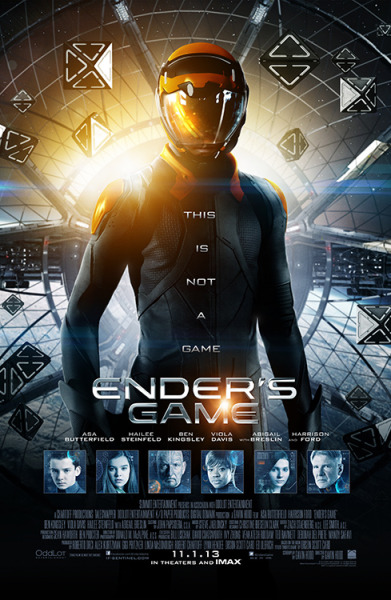
Ender’s Game is one of my all-time favorite books. So you
can imagine my excitement about the upcoming movie. I’ve been watching the
process since the production company was doing open calls for battle school
classmates of Ender back in the spring of 2012. I vaguely considered driving my
battle-school aged son down to New Orleans just so he could have a chance to be
part of this exciting work.
(image from I.F. Sentinal website - the official website for the Ender's Game movie.)
If you haven’t read Ender’s Game, warning: there will be
spoilers. Sorry! The book’s been out since the 1980s, if you haven’t read it yet, what have you been doing? Read Ender's Game. Then read this.
Here’s an excerpt from an amazon review:
Intense is the word for Ender's Game. Aliens have attacked Earth twice and almost destroyed the human species. To make sure humans win the next encounter, the world government has taken to breeding military geniuses -- and then training them in the arts of war... The early training, not surprisingly, takes the form of 'games'... Ender Wiggin is a genius among geniuses; he wins all the games... He is smart enough to know that time is running out. But is he smart enough to save the planet?
So you get the premise? Kid goes to Battle School, where, no
big deal bro – we just want you to save the planet. This message unfolds to
Ender as the book goes on. At first he is just really good at the games. He doesn’t understand how much the Powers That Be are pinning their hopes on him and him alone. How much they are manipulating
things behind the scenes to shape him into the kind of fighter they need. How
much he is a pawn.
Okay, you with me so far?
The movie previews I’ve seen (which you can find here) are
excellent. Harrison Ford as one of the Powers that Be, amazing, right? The look
is stunning, the young actor who plays Ender is convincing.
But the facebook marketing campaign? Oof. (They use the same content on Google+ if you prefer.)
It seems to me some marketing executive who has NEVER READ
THE BOOK is writing marketing copy to accompany images from the film. And it’s
killing me. One tagline reads: “From battle room to battlefield, he’s an underdog who finds a
way to win.”
First, that smacks of something a freshman-level high school
writing class may turn up. Second, underdog? The idea of an underdog is that
it’s someone you want to root for, someone you want to see succeed. The really
wild and tricksy part about Ender’s Game as a work of fiction is the way Orson
Scott Card manages to get you, the reader, to a place where you’re wishing for Ender to FAIL, because you want him to not be manipulated anymore.
You want him to break free of all the expectations and crap he’s been put through.
This tagline accompanies a new video preview on Instagram: “He'll
risk everything to keep us safe.”
Look, I’m thrilled to see mainstream media embracing today’s
social media tools like Instagram, but couldn’t they at least try to get the
messaging right? Ender isn’t in this because he wants to risk everything. He’s
been manipulated and shaped into a kind of killing monster, something which
plagues him throughout this book and into other books in this series. He’ll risk
everything because he wants to keep his sister, Valentine, safe. She’s all he’s
fighting for. Which is a perfectly compelling and exciting element of the plot.
Where is that messaging in the ad campaign?
To take this from the lala land of Hollywood to our own
writing, here’s a fair point. We need to be aware of the kinds of messages our
fiction carries. The important themes.
For some of us <ahem> discovery writers (aka “seat of
the pants” writers), we don’t always know or recognize the themes and messaging
of our stories until we’re done. And even then sometimes we need to take a step
back or talk with others who have read the story to fully understand what
people take away. But we need to do that, and we need to strongly consider
these overarching messages when we’re building our own marketing materials or
even just pitching our novels to agents, publishers, writing the blurb for the
back of the book, etc.
We need to be clear on what the work is trying to
accomplish, even if we have to reverse-engineer it and come up with this after
the fact. What mismatches between what a book or movie is actually about and
the marketing campaign that accompanies the work?
I know I, for one, will never again cavalierly write marketing copy without closely considering the theme and message of the work I'm writing copy for. After all. I'm the only hope I've got.
Labels:
adaptations,
marketing,
messaging,
movies,
theme
Thursday, September 5, 2013
The Last Unicorn
When
I was a little girl, my favorite movie was, without doubt, The Last Unicorn.
Growing
up and seeing it again, it’s a little silly. The character designs are so-so
(except of the unicorn herself), and there are a couple of songs that are kind
of cringe-worthy (the ones sung out of pitch by Amalthea and Prince Lir).
But
there’s still a lot of magic there. The dialogue is amazing, and the story
itself is unusual and beautiful. And yes, I still tear up at the first song.
And when she gets turned into a girl. And the ending. I still cry a lot at the
ending.
But
then, as I mentioned in my Awesome List post, I read the book, and it was
beyond incredible. Every beautiful bit of dialogue was lifted directly from the
book. And upon reading that, almost ten years ago, Peter S. Beagle became one
of the authors I want to emulate (not just for that book, though I do love the
particular writing style he uses there).
Imagine
my delight, then, to learn that Peter Beagle is taking The Last Unicorn movie on tour. They show the movie in the theater,
Peter answers audience questions, they raffle off some prizes, and then there’s a signing. (Interesting but
sad fact: up until a short while ago, Peter didn’t receive any money whatsoever
from the movie or video sales, even though he wrote both the book AND the
script).
Artwork outside the theater
It
was so much fun. Peter was extremely generous and friendly with his answers,
especially since he must have been asked these same questions hundreds of times
before. Here are a few highlights:
-He
had to entirely scrap the first draft of the book, which had the unicorn’s
companion as a two-headed demon that had been expelled from hell. To my
surprise, they’re actually releasing that version in a few years as part of a
special anniversary edition, I think.
-Peter
thinks that the character that most resembles him in the Last Unicorn is the
butterfly, because his mind also works in bits and phrases of music and poetry.
-When
he signed my book, I asked who some of his biggest literary/writing style
influences were in writing the book. Unfortunately, it was kind of loud and I
couldn’t hear what he said, and I was too shy to ask him to repeat himself. I
did catch T.H. White, and James Thurber.
-The live action movie rights revert to Peter in 2015. They're actually very interested in making a live version, and covering a lot of the things in the book that didn't translate well to animation. Christopher Lee would apparently be interested in taking part again!
Right
now the schedule of the tour (on the main website here) is somewhat limited, but they’ll be
adding more dates soon. They also had a lot of cool stuff on sale, including
art prints, t-shirts, and the entire book in teeny tiny print on a poster (!).
So I highly recommend the tour if you loved the movie as a kid and would like to see it again, or if you have little ones who might love the movie - who knows when you'll next have the chance to see it in a theater?
Wednesday, January 23, 2013
Austenland!
Hooray for ham!*
One of my top three favorite Shannon Hale books (the other two being The Goose Girl and Book of a Thousand Days) has been born in movie form!
It's been a long gestation, but well worth the wait according to happy Sundance moviegoers - and Sony who just acquired it for $3,000,000.
But see, I'm getting ahead of myself.
Long, long ago, way back in 2008, Shannon Hale wrote a book.
Austenland is the tale of unlucky-in-love Jane Hayes who is stifled by an unhealthy obsession with Mr. Darcy, as played by Colin Firth. No man or relationship will ever measure up (this she knows - she even has all her past boyfriends numbered beginning with a grade school crush). When Jane is bequeathed a three-week vacation to an English resort based on Jane Austen's novels, she apprehensively accepts, determined to get Mr. Darcy, and truth-be-told, all men, out of her system forever. But once there, robed in chemises, pelisses, day dresses and spencer jackets, Jane finds herself swimming in deeper water than she expected. The gentlemen actors are scrumptious with their top hats and side burns, her fellow vacationers both hilarious and endearing, but what is she really looking for, and what does reality mean when you're in Austenland?
It's a great book that hits all the right notes on America's obsession with all things British in general (*ahem* Downton Abbey *ahem*) and Jane Austen in particular.
Not long after the writing of said novel, a couple of Shannon Hale's friends (Stephenie Meyer, a la Twilight, and Jerusha Hess, a la Napoleon Dynamite) got a hold of it and together they dreamed of making it into a movie.
In July 2011 Shannon announced on her website that their dream was going to become a reality. Shannon and Jerusha wrote the script, Stephenie's company produced, and Jerusha directed. I was going to link to some of the hilarious posts Shannon wrote from the set in England, but there are just too many. I highly suggest going to her site and just reading forward for a few weeks starting July 5, 2011.
The cast had a blast filming, and apparently the camaraderie came through on the celluloid (pixels?) as well. Austenland was picked up for release at Sundance, an honor in and of itself. And the audience and critical reaction at the sold out showings has be gratifyingly positive.
I can't wait for this to hit the regular theaters. What an awesome thing to happen to a fabulous writer!
You go, girl (and girls, including Stephenie and Jerusha).
What other books are on your wish list to become movies?
~ Susan
* "Hooray for ham" was the line that cracked me up today as I was rereading Austenland for the umpteenth time.
One of my top three favorite Shannon Hale books (the other two being The Goose Girl and Book of a Thousand Days) has been born in movie form!
It's been a long gestation, but well worth the wait according to happy Sundance moviegoers - and Sony who just acquired it for $3,000,000.
But see, I'm getting ahead of myself.
Long, long ago, way back in 2008, Shannon Hale wrote a book.
Austenland is the tale of unlucky-in-love Jane Hayes who is stifled by an unhealthy obsession with Mr. Darcy, as played by Colin Firth. No man or relationship will ever measure up (this she knows - she even has all her past boyfriends numbered beginning with a grade school crush). When Jane is bequeathed a three-week vacation to an English resort based on Jane Austen's novels, she apprehensively accepts, determined to get Mr. Darcy, and truth-be-told, all men, out of her system forever. But once there, robed in chemises, pelisses, day dresses and spencer jackets, Jane finds herself swimming in deeper water than she expected. The gentlemen actors are scrumptious with their top hats and side burns, her fellow vacationers both hilarious and endearing, but what is she really looking for, and what does reality mean when you're in Austenland?
It's a great book that hits all the right notes on America's obsession with all things British in general (*ahem* Downton Abbey *ahem*) and Jane Austen in particular.
Not long after the writing of said novel, a couple of Shannon Hale's friends (Stephenie Meyer, a la Twilight, and Jerusha Hess, a la Napoleon Dynamite) got a hold of it and together they dreamed of making it into a movie.
In July 2011 Shannon announced on her website that their dream was going to become a reality. Shannon and Jerusha wrote the script, Stephenie's company produced, and Jerusha directed. I was going to link to some of the hilarious posts Shannon wrote from the set in England, but there are just too many. I highly suggest going to her site and just reading forward for a few weeks starting July 5, 2011.
The cast had a blast filming, and apparently the camaraderie came through on the celluloid (pixels?) as well. Austenland was picked up for release at Sundance, an honor in and of itself. And the audience and critical reaction at the sold out showings has be gratifyingly positive.
You go, girl (and girls, including Stephenie and Jerusha).
What other books are on your wish list to become movies?
~ Susan
* "Hooray for ham" was the line that cracked me up today as I was rereading Austenland for the umpteenth time.
Tuesday, January 15, 2013
Emotional Payoffs
There are about five movies that I will always sit down and
watch, over and over again. One of them
is Titanic. I love that movie. It’s got romance and action and set in one of
the most fascinating and tragic moments in history, and I’m a little shy to
admit it, but I love, love, love, “The Hearts Will Go On” theme song by Celine
Dion.
SPOILERS (but really who hasn't seen this movie?)
Sometimes logic needs to take a backseat in storytelling
(not always, just sometimes). Stories,
for the most part, are an emotional experience, and anything that gives an
emotional payoff takes precedence over logic.
SPOILERS (but really who hasn't seen this movie?)
But there is one scene that grates on me every time I see
the movie. It is when Rose gets on a
lifeboat, and as she is lowered from the sinking Titanic, she looks up at Jack
and jumps back onto the ship. I
understand that it is supposed to be a great, emotional moment, showing that
Rose is choosing Jack. She is choosing
to stay on a sinking ship just to be with him.
She is giving everything up, her wealth, her privilege, her safety
because she loves him too much to leave him.
I think it is supposed to be a great romantic moment, but I hate
it. It is the one flaw in what could’ve
been a perfect movie.
The reason this moment is so passionately despised by me is
that in that one action Rose essentially kills Jack. In the end when Rose and Jack are in the
water, he dies of hypothermia because there is no room for him on the slab of
wood. If Rose had stayed on the lifeboat,
Jack could’ve had the slab, and he would’ve been the one who was pulled out of
the icy water.
I would forgive Rose for killing Jack if her actions had
been noble, if she had given her spot to another passenger, but she doesn’t. She gets on the lifeboat and then changes her
mind about being saved and jumps off when it is too late for someone else to
take her place. Rose knows that there
aren’t enough lifeboats that half the people on the ship are going to die, and
yet she takes a spot and then leaves it, without thinking about how she selfishly
stole a chance from someone else to survive, like one of those little children
that died with their mother (that scene was heartbreaking).
That scene could’ve so easily been rewritten so that Rose
either nobly gives her seat to someone else or doesn’t have the option of
getting on a lifeboat after she saves Jack from the brig. Plot-wise there was no need for that scene.
But I doubt I’m seeing something that James Cameron didn’t
see. He is a master story teller. His skills are way beyond mine. He has written/directed/produced some of my
most favorite movies of all time. I
seriously doubt that if he somehow magically came across this blog post he
would think, “Wow, this chick has a point.
Why didn’t I or the other hundreds of other people working on this movie
realize that Rose basically kills Jack?"
So why would James Cameron choose to have Rose jump back
onto the ship? I’ve never asked him nor have
seen or read anything about him discussing this, but I’ve thought about this a lot, and
I think I’ve got a decent answer.
It is all about emotional payoffs.
I read this blog post by writer Alexandra Sokoloff a while
back on “What
Makes a Great Climax.” In this post,
Alexandra talks about the ending of the movie Jaws (SPOILERS).
It is powerful ending, where Sheriff Brody is hanging off of the mast of a sinking boat with his gun and Jaws is coming right at him, chewing on the oxygen tank. Brody shoots at Jaws aiming for the oxygen tank but keeps missing until the shark is almost upon him and then he shoots the tank and Jaws explodes.
In her post, Alexandra talks about how author of the book and
co-screenwriter of the script Peter Benchley reported arguing with Spielberg
over the ending. Benchley thought the
shooting-the-oxygen-tank death of Jaws was completely implausible, that
audience wouldn’t buy it. But Spielberg
believed that if he drew the audience in on this emotional journey that they
would go with it, that they would trust him.
I’m going to quote Alexandra directly here because I love
how she worded this in her post.
“Spielberg paid that movie off with an
emotional exhilaration rarely experienced in a story. Those characters EARNED
that ending, and the audience did, too, for surviving the whole brutal
experience with them. Brilliant filmmaker that he is, Spielberg understood
that. The emotion had to be there, or he would have failed his audience.”
So maybe blowing up a shark by shooting at an
oxygen tank he just happens to be munching on isn’t the most plausible way to
kill a shark, but there is a huge emotional payoff there, in seeing the shark
that had tortured Brody and killed and maimed his friends die in such a
dramatic way. It doesn’t have to be
logical as long as it delivers the emotional payoff that the audience wants. Honestly, I think that scene was
brilliant. It certainly worked for me.
I think that is the reason Rose had to jump from
the lifeboat back on to the Titanic.
That was a big, emotional moment, and the scene needed to be big and
emotional. Rose needed to make that
choice, choose to be with Jack and give up everything to be with him, and if
she had missed the lifeboats, she wouldn’t have been able to make that choice. And if she had given her spot on the lifeboat
to someone else, that moment of choosing Jack wouldn’t have been dramatic enough. It was the turning point of her character
arc, and that moment had to be big.
If you are on the emotional journey with Rose,
you’re not supposed to be thinking about her taking someone else’s spot or how
Jack might have survived if she had stayed on the lifeboat. You’re just supposed to be relieved that she
chose Jack over Cal and her mother and that soulless life of wealth and privilege
that was destroying her spirit.
I
think the take home message here is that there are those moments that need to
be emotional and need to be big to give the audience or readers the emotional
payoff that they are waiting for. And these
are the times when logic sometimes has to step aside because the story comes first, and
you have to do what is best for the story even if it isn’t what is most logical. Of course there will be readers who might be
annoyed with the lapses of logic, but those are the ones who are not
emotionally invested. You need to give
that emotional payoff to your readers who are.
So
tell me, did that scene in Titanic bug you too or were you too emotionally invested to think about it?
~MaryAnn
Saturday, December 1, 2012
Gone Girl and the Pitfalls of the Big Twist
The last book I read was a nail-biter, the kind of book that kept me up all night desperate to know how it ends. The answer was true to Amazon reviews: disappointingly. But don’t worry, I won’t spoil the ending, because that would ruin the whole thing.
So I'll only spoil the middle.
Gone Girl, by Gillian Flynn, is a psychological suspense novel about a missing wife and a marriage that has gone horribly wrong. If you haven’t read it yet, don’t read the reviews that spoil the ending. Go out and buy it - I’m still 40th on our library waiting list- then read 219 pages and get back to me. (If you can’t tear yourself away from this post, then I assure you the spoilage will change how you read this book but not ruin it. It might even make you like it better. Or it might not. No money-back guarantees in the blogging business, my friends.)
Go on. I'll just hang out here and wait.
![]() |
| By Leyo (Own work) [GFDL or CC-BY-SA-2.5-ch]via Wikimedia Commons |
I'm betting you didn't stop at 219. Couldn't put it down, right? I assume it’s Tuesday and you’re checking back in.
So you’ve started Part 2. For the first half of the book, the narrative has alternated between Nick’s POV in the present day and Amy’s diary entries beginning years earlier. On the day Nick's story began, Amy disappeared from the house, leaving traces of blood and signs of a struggle. Nick has been muddling through the police investigation while Amy's diary has reflected increasing strain between them.
Now we’ve gotten to know both Nick and Amy a bit, and we know something isn’t adding up. Their marriage is clearly troubled, and he is lying to the cops and might even be lying to us, the readers, because there’s something sketchy about Nick. And Amy seems oblivious sometimes, even as she seems to understand their dynamic so well.
If you’re like me, you’ve seen a little more of yourself in Amy than you’d like to admit. The way she tries so hard to be an easy wife, to not let his little guy habits get to her. The way she compares them with other couples while pretending not to. The way she seems to be trying to create a picture of happiness while not being entirely sure if she’s actually feeling it.
If you’re like me, you might have put the book down few chapters in, when you were starting to see how Amy might drive Nick insane, and said to your husband, “So, ah, promise not to murder me, okay?” And he might have frowned and said, “I already promised not to push you down the stairs after you watched that Lifetime movie and I am not making any more promises because I really. Shouldn’t. Have to.” And then you might have pouted for a minute before sinking back into your book, pushing aside the feeling that the author knew you too well.
This was in the beginning, before things got weird. You just suspected Nick was angrier than he seemed and Amy was more desperate than she seemed, and it all was a little too keen, as though the author had taken a shadow and managed to give it form, then sharpened that form to a blade and sliced open every marriage ever.
Or maybe you were just engrossed in the story. To each her own.
You got sucked in deeper, stayed up later, and found yourself on page 219. The midpoint reveal. You knew there had to be one, because nothing added up so far. You may have even floated this in your head, or maybe you positively saw it coming all along. I worried the story might go off the rails, but never anticipated the degree to which Flynn carries her twist through. Whether or not you guessed the twist, if you are like me, even a little bit, you were not happy with this turn of events.
Because if you are like me, you love reading about characters who betray each other but you are less enthusiastic about characters who betray you, the reader.
Okay. This is your final chance to catch up. I'm not going anywhere. Spoilers come after the manatee.
![]() |
| By Chris Muenzer (Flickr) [CC-BY-2.0], via Wikimedia Commons |
Ah, you’re back.
Page 219: Not only did Amy fake her own death, she faked all those diary entries. That character who hit a little close to home, whose vulnerabilities were so perfectly blended into an everywoman that I could understand and envy and pity all at the same time? Yeah, she was fake. The real Amy made her up. The real Amy played a joke on everyone, including the reader. And since the real Amy is not real, but made up by the real author, I had some less than kind thoughts for Ms. Flynn on page 219.
I knew there had to be a twist in order for the story to make sense, but I still groaned out loud when this was it. It took me another fifty pages to get over the resentment and get into the new story - the one featuring a sociopath instead of a victim.
Elements of the TWIST FAIL:
Not everyone will be as bothered by this plot twist as I was, and you can’t please everyone all the time, but if you want to please this cranky blogger I recommend avoiding two pitfalls of a big twist:1. Abusing the Reader’s Trust
Unreliable narrators can be tricky, but they can also work. If you’ve made it this far, you know that Nick is having an affair, and he didn’t tell the reader upfront. Instead, when his girlfriend forces her way onstage, he makes a reluctant confession to the reader:
I have a mistress. Now is the part where I have to tell you I have a mistress and you stop liking me. If you liked me to begin with. I have a pretty, young, very young mistress, and her name is Andie.
I know. It’s bad.
Nick has committed some lies of omission in his narrative, making him an unreliable narrator. But Andie doesn’t contradict the picture of Nick. She fills out another piece of the puzzle, and it fits with everything that came before.
As I reader, I don't feel like I bit into my next Goober and got a Raisinet instead.
Amy's twist, on the other hand, is like having your delicious chocolate covered peanut snack replaced by chocolate covered raisins in the middle of the movie. And I have always thought that fruit and chocolate is something a person needs time to get used to.
I was invested in Amy's character. I knew she was holding back, but I thought I related to her. Finding out those diary entries were all supposed to be a lie was kind of like spending 200 pages of my life with a someone I think might be a friend and instead turns out to be doing market research. A lot like that, actually. Maybe I should spend more time with real people. But that's for another post.
2. Forgetting the Limits of Your Authorly Control
Books are at a disadvantage compared to movies. A movie always has one ultimate viewpoint: the camera’s. You can stick with one character, or have voiceovers, but basically what the camera sees is what the audience sees. In The Sixth Sense (a.k.a. best twist ever), we could go back and see all the bits that the camera caught that we had missed, all the ways to look at a scene differently once we understood that there was another angle.
A movie never relinquishes control to the viewer. We might puzzle over things or even miss them entirely, but we don’t generally fill in any details with our imaginations. In a movie, you get what you get.
Authors don't have that kind of control. We readers have to form our own images, and we use our imaginations on every single page to make the world of the story richer. Characters and settings become uniquely three-dimensional in our minds. I kept picturing Nick and Amy in a house just like one I’d seen when my husband and I were house hunting several years ago. If I read a detail that contradicted my image, I’d adjust. But the image was there already, based on only a few details from the author and the pictures my brain had in storage. I’ve never been to Missouri, so the suburbs I pictured were more like Michigan, because that’s what my mind filled in. Gillian Flynn couldn’t have stopped me. The author can't control every detail, or decide how invested a reader becomes in his or her imagination.
This means that changing critical things late in the game is dangerous.
If you give a few telling details about a woman - a hunched back, a shuffling gait, gray hair - and for 200 pages, I picture an old lady, it won't work to say on page 201 that she’s actually a young woman. No matter how many details you tell me, it would take some mind-blowing writerly chops to make me to picture something that could be either an old lady or a young woman without giving away your surprise.
As I read, I create images based on my interpretation of the story. In a movie, I have no choice but to interpret the image you show me. In that case, painting a picture that can be seen two ways is easy peasy lemon squeezy:
For a great analysis of what makes a twist really work, see MaryAnn's brilliant post: Pulling off The Big Twist.
Maybe I wasn't supposed to relate to Amy as much as I did. Maybe I was supposed to smell that she was off from the outset, or maybe I wasn't supposed to be rooting for her. Maybe I wasn't supposed to picture the diary entries as vividly as I did, or get so attached to them. But Ms. Flynn couldn't have controlled that without giving away the surprise.
A book might be born in one person's creative mind, but the experience of reading it is always collaborative, a meeting of the author's words and the reader's imagination. So before you introduce a twist, ask yourself if you’ve anchored the reader in the right images, and if the promises you made along the way are the ones you meant to make. Some people love surprises and some people hate them, but no one likes a broken promise.
For a great analysis of what makes a twist really work, see MaryAnn's brilliant post: Pulling off The Big Twist.
I'm off to order Gillian Flynn's other novels. Story critiques aside (we haven't even talked about the ENDING!), Gone Girl was a heckuva fun read and I can't wait to do it again.
Tuesday, November 20, 2012
Make Them Suffer
![]() |
| Yes I know this isn't Skyfall. |
I’m not going to give anything away since I know the movie
just came out, but if you’ve seen Casino Royale and Quantum of Solace you know
what I mean. These writers aren’t afraid
to make Bond suffer emotionally and physically.
Every movie puts Bond through a wringer.
I feel kind of bad that I like to see characters suffer
almost like I’m a little sadistic, but honestly, I think making the characters
suffer ups the stakes, it makes you feel that they have a lot to lose and that
success isn’t a given, in fact, it is almost impossible, and that ratchets of the
tension while making the hero feel vulnerable, more relatable. And that is what I personally like in a
story.
Leverage
I started watching Leverage a TV series when it first came
out. And I thought it was really clever. It was about a team of ex-thieves and ex-con
artists conning bad thieves and bad con artists who are ripping off innocent
people. Of course the noble team gives
most of the money back to the original victims of the bad guys and keeps only a
small percentage for themselves. It’s kind
of a modern day Robin Hood and his merry men.
I’ve always loved a
good heist flick, so I was pretty excited about this show. And really it had everything I like in a good story, interesting and fun
characters with a lot of clever dialogue and twists with great character-character dynamics, and I’m sure that there are a ton of people who love this
show (and I do understand why), but I gave up on the show after four or five
episodes, and it took me a while to figure out why this show didn’t work for me.
In every episode that I watched there was a point when their
mark was on to them, and it looked like their whole scam was unraveling, but in
the end, it was always revealed that they had planned the whole thing, that the
mark catching on was just part of the con.
It was really clever how everything came together and how they tricked
the bad guys, but it go really old really fast for me.
I realized the show didn't work because there was a the lack of stakes. The team never really suffered or struggled. They were always better, smarter, one step ahead of everyone else, and while it was cool that they were so awesome, but it also made them less interesting, less real, less human. And while it is fun to watch a group of criminal geniuses pull off a clever con, it is more fun to watch that clever con fall apart completely and leave the team scrambling and struggling to pull the pieces together and somehow managing to regroup and pull off an even cleverer scheme, like in the movie The Italian Job.
Elena vs. Bella
Just because Breaking Dawn was recently released and I haven’t
blogged about Twilight in at least a couple of months, I feel the need to
mention Breaking Dawn. I’ve blogged before
on how I felt about Bella’s transition into a vampire was too easy (you can
read it here),
but the recent episodes of Vampire Diaries have made me think about this a
little more (WARNING: massive spoilers
for both Breaking Dawn and Vampire Diaries).
This season in Vampire Diaries, the main character, Elena,
has just turned into a vampire. There
are a lot of parallels between Elena and Bella since they are both human girls
who fall in love with a vampire (or vampires in Elena case), but unlike Bella,
Elena never wanted to be a vampire. More
than anything, she wanted to remain human.
Even in times where her problems would be solved if someone just turned
her, she always chose the harder path of staying human. So she wasn’t happy at all about being
turned.
In the past several episodes, Elena has struggled immensely with
being a vampire. She can’t keep down
animal blood and has to drink human.
Enjoys drinking blood a little too much, and almost killed her human friend
who was a willing donor. She struggles
between that predator vampire side and her overly compassionate human nature. Even though she is super strong and wicked
fast and will be young forever, the down side of drinking blood and nearly killing
people is torturing her. And for
additional angst, her vampire boyfriend, Steffen, is having a hard time adjusting
to the new Elena because he’s struggled immensely trying to keep those murderous
urges in check and seeing those aspects of himself that he loathes in Elena has
put a strain in their relationship. This
all translates into lots of tension and conflict, and I think it makes for a
very compelling story, and I’m really enjoying this season.
Honestly, this is where I thought Breaking Dawn was going. There was all of this build up about how hard
it was to become a fledgling vampire, and I really thought Breaking Dawn would
focus on Bella struggling to adapt to be a vampire and maybe even some conflict
between Bella and Edward because of how becoming a vampire changed her. It felt like a natural place for the story to
go, and I was disappointed that Bella had no struggles at all in becoming a
vampire. I thought it was a missed
opportunity for lots of great internal conflict that would have enhanced the
tension of the story.
I just think that there is something about seeing a person
or character suffering that makes us empathize and care more about that
them. Although, I do think that there is a
limit. You shouldn’t go out of your way
to make your character’s suffer. That
can feel just as false as going out of your way to protect your characters. Also, it can be emotionally exhausting for the
reader when everything goes wrong and the character loses everything. Like in all aspects of writing, there needs
to be a balance. I’ve heard the saying
that a writer should essentially chase the character up a tree and then throw rocks
at him, and I’d like to add that maybe the writer shouldn’t go a step further and burn the tree down. There is a limit to making your characters suffer,
but you should make them suffer.
~MaryAnn
Subscribe to:
Posts (Atom)