
Ender’s Game is one of my all-time favorite books. So you
can imagine my excitement about the upcoming movie. I’ve been watching the
process since the production company was doing open calls for battle school
classmates of Ender back in the spring of 2012. I vaguely considered driving my
battle-school aged son down to New Orleans just so he could have a chance to be
part of this exciting work.
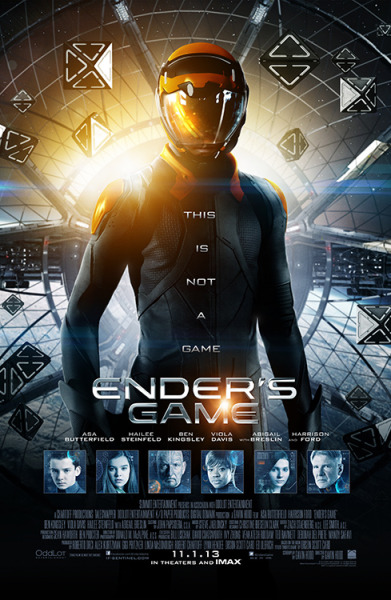
(image from I.F. Sentinal website - the official website for the Ender's Game movie.)
If you haven’t read Ender’s Game, warning: there will be
spoilers. Sorry! The book’s been out since the 1980s, if you haven’t read it yet, what have you been doing? Read Ender's Game. Then read this.
Here’s an excerpt from an amazon review:
Intense is the word for Ender's Game. Aliens have attacked Earth twice and almost destroyed the human species. To make sure humans win the next encounter, the world government has taken to breeding military geniuses -- and then training them in the arts of war... The early training, not surprisingly, takes the form of 'games'... Ender Wiggin is a genius among geniuses; he wins all the games... He is smart enough to know that time is running out. But is he smart enough to save the planet?
So you get the premise? Kid goes to Battle School, where, no
big deal bro – we just want you to save the planet. This message unfolds to
Ender as the book goes on. At first he is just really good at the games. He doesn’t understand how much the Powers That Be are pinning their hopes on him and him alone. How much they are manipulating
things behind the scenes to shape him into the kind of fighter they need. How
much he is a pawn.
Okay, you with me so far?
The movie previews I’ve seen (which you can find here) are
excellent. Harrison Ford as one of the Powers that Be, amazing, right? The look
is stunning, the young actor who plays Ender is convincing.
But the facebook marketing campaign? Oof. (They use the same content on Google+ if you prefer.)
It seems to me some marketing executive who has NEVER READ
THE BOOK is writing marketing copy to accompany images from the film. And it’s
killing me. One tagline reads: “From battle room to battlefield, he’s an underdog who finds a
way to win.”
First, that smacks of something a freshman-level high school
writing class may turn up. Second, underdog? The idea of an underdog is that
it’s someone you want to root for, someone you want to see succeed. The really
wild and tricksy part about Ender’s Game as a work of fiction is the way Orson
Scott Card manages to get you, the reader, to a place where you’re wishing for Ender to FAIL, because you want him to not be manipulated anymore.
You want him to break free of all the expectations and crap he’s been put through.
This tagline accompanies a new video preview on Instagram: “He'll
risk everything to keep us safe.”
Look, I’m thrilled to see mainstream media embracing today’s
social media tools like Instagram, but couldn’t they at least try to get the
messaging right? Ender isn’t in this because he wants to risk everything. He’s
been manipulated and shaped into a kind of killing monster, something which
plagues him throughout this book and into other books in this series. He’ll risk
everything because he wants to keep his sister, Valentine, safe. She’s all he’s
fighting for. Which is a perfectly compelling and exciting element of the plot.
Where is that messaging in the ad campaign?
To take this from the lala land of Hollywood to our own
writing, here’s a fair point. We need to be aware of the kinds of messages our
fiction carries. The important themes.
For some of us <ahem> discovery writers (aka “seat of
the pants” writers), we don’t always know or recognize the themes and messaging
of our stories until we’re done. And even then sometimes we need to take a step
back or talk with others who have read the story to fully understand what
people take away. But we need to do that, and we need to strongly consider
these overarching messages when we’re building our own marketing materials or
even just pitching our novels to agents, publishers, writing the blurb for the
back of the book, etc.
We need to be clear on what the work is trying to
accomplish, even if we have to reverse-engineer it and come up with this after
the fact. What mismatches between what a book or movie is actually about and
the marketing campaign that accompanies the work?
I know I, for one, will never again cavalierly write marketing copy without closely considering the theme and message of the work I'm writing copy for. After all. I'm the only hope I've got.


