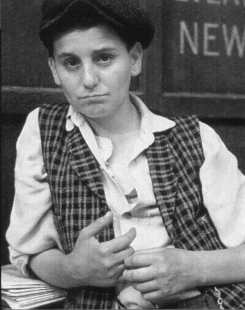
"In 1899, the
streets of New York City
echoed with the voices of Newsies...On every street corner you saw them
carrying The Banner, bringing you the news for a penny a pape."
How can people not
like this movie???? Seriously! I am shocked when I express my adoration of it,
and people laugh. Have they never seen this piece of genius? (Christian Bale said, “You say
something bad about Newsies and you have an awful lot of people to
answer to.”) I'm
one of those people. Sadly, I've never seen the Broadway version of it. But
I've got a dream...
The movie came out
while I was in college, and I was unexcited when my mom wanted me to see it--a
musical about child labor. Thanks, Mom.
Not long after
that, I memorized it. Pieces of it anyway. After I had
children of my own, they loved Newsies as much as I did. We watched it over Thanksgiving
vacation this year. ("How could you find time
for this, when you are slaving away on your newest Nanowrimo masterpiece?"
you may ask, but that's a question for a whole other post. Sorry.) One of the things
that make Newsies great is its well-developed minor characters.
If Jack Kelly is going to become the leader of the Newsboys
Union, he needs a few people to lead, right? But the story isn't about
them. It's about Jack. All he really needs are some faceless boys dancing
behind him, cheering occasionally. Yet I know them, and I love them, even the ones that
barely had a line to say. Here's how I think the authors (Bob Tzudiker and Noni White) pulled
it off:
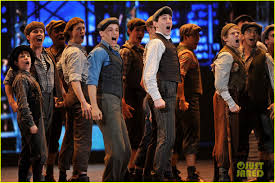 |
Newsies: The Broadway Musical
Group Consciousness |
Right off the bat,
we learn that the newsies are poor orphans and runaways, without a leader.
Some of them sleep on the streets. The lucky ones live in the Newsboy Lodging
House, which is a huge dormitory filled with boys. When the kindly landlord
wakes them up first thing in the morning, they are clearly exhausted. Like most
boys, however, they wake up quickly, and spend their morning hitting each other
and jumping off things.
However, these boys
have grown-up responsibilities. The nuns give them bread for breakfast, and
then the newsies hurry off to see the day's headlines. A dull headline might
mean the difference between starvation and a good meal. These kids also have to
worry about bullies, of course. What kid doesn't? But loyalty is important to
the Newsies, and they protect each other's back.
Every single one of
them seems confidant in the life they have chosen, and they carry their burdens
lightly. It almost seems like a happy life. Then they get their day's papers.
Taking a collective breath, they disperse into the streets. You realize that
those few moments of camaraderie are all they get. The Newsies lead a
remarkably solitary life.
When you have a
large cast of characters that all have the same purpose--in this case,
surviving on the streets by selling newspapers--allowing them to have a group
consciousness can imbue them all with the beginnings of a personality without
having to build each one from scratch individually.
In Newsies, none of
the minor characters ever truly deviate from the group consciousness, or at
least not in a way that a rousing song can't fix. In a book, there would
probably be more time to allow them to walk their own paths.
Individual Personalities
Still, they have
their own personalities. They each have two or three unique things about them,
and every sentence they say; every moment they spend on screen, is spent
highlighting those individual differences. Here are a few examples
Racetrack: The Witty Gambler with the Charm
Even Racetrack's
name tells you what makes him unique. He's a gambler, though he looks like
he's maybe fourteen, tops. When Jack (Cowboy) gets in a fight with the two
bullies, Oscar and Morris, you can hear Racetrack shout , "Five to one
that Cowboy skunks them. Who's betting?"
Racetrack is a
charmer and a gambler, but he is also brave to the point of stupidity when it
comes to defending women and his friends. The idioms he uses, the way he speaks
to adults, every single moment of his on-screen time is spent hammering that
into our heads.
Midway through the
movie, Racetrack is dragged to the police station. He was knocked unconscious
while trying to protect a singer named Mette during a riot. After Racetrack and
his friends are arrested and fined $5.00 each, he speaks to the judge on behalf
of everyone. "We ain't got five bucks...we ain't even got five cents. Hey,
your honor, how about I roll you for it? Double or nothin'." Classic Racetrack.
Crutchy: The Cheerful, Independent Newsie With the Bad Leg
The origins of
Crutchy's nickname are pretty obvious--he has a bad leg, so he walks with a
crutch. Crutchy is perpetually cheerful and polite. In contrast to the other
Newsies, who don't try to hide their dislike the man who sells them papers, when Crutchy greets him, he says, "Heya, Mr. Wisel." When he gets
his papers, he thanks Mr. Wisel as profusely as if he'd just done Crutchy a
personal favor.
Crutchy takes every
opportunity to point out the good in his fellow Newsies. "You're getting
the chance of a lifetime here, Davey," he calls at one point. "You
learn from Jack, you learn from the best."
The first time the
Newsboy Union gets into a fight, Crutchy is gleefully destroying newspapers,
and doesn't notice that the police have arrived to restore order.
Obviously he needs more time to escape than most of the Newsies, but he only
looks up when Racetrack turns back to yell, "Crutchy! Scram! Scram!"
He doesn't scram in
time, and gets beat up and sent to The Refuge, a jail for children run by the wicked Snyder.
When Jack and David arrive to break him out, Crutchy is all smiles, as usual,
but he explains that he can't go. "I ain't walkin' so good," he says.
"Oscar and Morris kinda worked me over." Jack offers to carry him
out, and for the first time, Crutchy's smile is gone. "Hey! I don't want
no one carrying me. Not ever!" Then he protects Jack and Davey by
distracting the warden so they can leave.
The next day, the
whole group is antsy. They are scared about what they did yesterday, worried
about the consequences and angry about the unfairness of it all. Davey is doing
his best to keep everyone calm, but Jack's shout of "Let's soak them for
Crutchy!" is like setting a match to gasoline. Although Crutchy doesn't
get much more screen time, his memory serves as a rallying cry more than once.
And finally...Spot Conlon: The Young, Powerful
Leader with the Great Eyes
Ah Spot. We don't
even hear his name until half way through the movie, and yet, at least in my
house, he gets more screen time than any other actor. (That's because we rewind
the scenes he is in. J)
Spot is the leader
of the Brooklyn Newsies, and his name strikes fear in the hearts of Newsies
everywhere. Spot's Newsies are huge compared to everyone else, but Spot himself
is nothing but a kid--about the same size as Racetrack, and quite a bit smaller
than Jack. People listen to him though, because he is street-wise and a good
leader, with a knack for military tactics.
When Jack, Davey and Boots arrive in Spot Conlon's territory,
Spot has already heard about the Newsies' strike. He refuses to join. Davey
does his best to sweet-talk Spot, and it kind of works. Spot is flattered, and decides
Davey is a great guy. However, he does not change his decision.
Spot:
How do I know you punks won't run the first time some goon comes at you with a
club? How do I know you got what it takes to win?
Jack:
Because I'm telling you, Spot.
Spot:
That ain't good enough, Jacky-boy. You gotta show me.
Spot saves the day more than once, with such great style
and background music that I could watch it over and over, all these years
later. However, Spot's dialect kind of bugs me, so there aren't a ton of great
Spot quotes. There are a couple though:
Spot: Hey, your honor, I object.
The judge: On what grounds?
Spot: On the grounds of Brooklyn, your honor.
And my niece's favorite: "I say, that what you say, is
what I say."
If you want well-rounded characters without granting them a
lot of space in your writing, imbue them with a group consciousness, and two or
three unique characteristics. Every word they say and every action they take
should serve the double purpose of furthering your plot and developing those
characteristics.
If you have any examples of books that do a great job
developing a group of minor characters, I'd love to hear about them.