Tuesday, May 8, 2012

Shhhh...My Mom is a Bookaholic


My mom loves to read.  She always starts her day reading through the entire newspaper.  She always has a stack of books by her bed and burns through about three or four a week.   If there is any book of any genre lying around, my mom will pick it up and read it.  I don’t think there has ever been a book she has started that she hasn't finished.  She is indeed a bookaholic.

She told me once that when we were really little, she had to ban herself from reading.  She gets so into books that she forgets to feed and care for small children.  I can relate.  There has been more than a few times when I’ve gotten so into a book that I glance at the clock and realize it is time for dinner, and I never even fed my kids lunch.  Yikes!  My kids are old enough now that they don’t let that happen.

I’m sure she’d rather I didn’t share this, but there was one time when I was in high school that I called her up for a ride home from school.  I decided to start walking to meet her and ended up walking all the way home (over two miles).  I went into our house to find my mom laying on the floor in the living room reading.  Of course she was so apologetic, and I know she felt really bad about forgetting me.  She had planned to sit down for just a minute to finish a chapter and got carried away.  In her defense, this only happened once.  But I understand her need to avoid reading when we were really young.  Clearly my mom has a problem.  She just really, really, really loves to read.

She never pushed reading on us kids.  She was always willing to read to us or listen to us read, but she never forced anything on us.  And honestly I don’t remember reading much with her as a child although I’m sure that I did.  I’ve blogged before how I wasn’t in to reading as a child, but I think my mother’s example of always reading something was a huge influence on me. 

And she loved to talk about books.  Every book I read for high school English class, she had either already read or would pick up my school copy and finish reading it before I did.  And I remember several times discussing those books with her.  She was incredibly insightful, pointing out things that weren’t discussed in class.  She not only read a lot, but she read critically and thoughtfully.

I don’t think she did this on purpose, but there were a few activities she did with us kids that really inspired my love for storytelling.

       Libraries and parks.  My mom took us to libraries a lot.  When I was little, there was this one library next to a park, and after we'd go to that library, we’d take our library books to the park and sit on a blanket and read them.  Of course we’d play on the playground a little too, but what I remember most was reading books on a blanket under a tree in that park.  We loved it.

       Popcorn parties.  This one didn’t have to do with reading, but storytelling.  During the summer, every once in a while, we would have a popcorn party.  We would bake cookies, pop popcorn, and make Lemonade.  Then we would go sit out in lawn chairs after     dark and tell each other stories while we ate our treats.       Sometimes we would play the game where one person starts     a story and we would go around in the circle all taking turns telling the next part of the story.  We had so much fun.  It was one of my best childhood memories. 

I really loved having a bookaholic for a mom, except maybe for that one time when I had to walk all the way home from high school, but hey, that was good exercise.  She was a great example.  Her love of books was palpable and showed me how important reading and stories really are, and I don’t think I would be an aspiring writer if my mother hadn’t shared her love for books with me.

Thanks Mom for everything.  I love you.  Happy Mother’s Day.

~MaryAnn

Monday, May 7, 2012

What Kind of Princess Are You? Guest Proser Connie Dabel

So my family and I just got back from the Mormon Rivera (also known as Disneyland) and my brain is what's known as fried. We had a great trip. Super fun. We met Minnie, and Goofy, and Darth Vader, and also Sabrina. That's her looking gorgeous, and me looking like I just spent the day at Legoland.


In my absence( brain absence), here's a post by the brilliant Connie Dabel. She's the first writer I ever met, and I have to say probably my favorite writer ever. She's also my mom.  One day, I'll have to write about her influence on me as a writer, but for now, I'll let her words speak for herself.

Thanks mom.

~Sheena

What Kind of Princess Are You?


Today I have been thinking about princesses, what with Disney's decision to once again put one of their movies back in the vault where they are safe and no one can get to them. A Disney movie usually has to have a princess and I guess they feel that a princess needs to be protected.

I have narrowed it down to three kinds of princesses in the world from what I can figure out.   

The first is a women who thinks she is a princess.   She doesn't feel a need to learn any skills or do any work, because she has her princess looks and that says everything about her.  Anyone with a half a brain can see that everything should be done for her.  

I knew a women once who had a small sore on her check.  She stayed away from the public eye for two weeks.  Not even venturing from her castle, because of the small band aid on her face.  Any good that she could have done was left undone because of her deep belief that a princess is beauty, and beauty alone.


The second princess is one who doesn't believe that she is one.   Someone never told her, and more important she never told herself, that she was a heir to kingdom and could and should take her place with all of the other princesses.   She is a women who is blown by what ever breeze prevails.   That is the way she will go until someone tells her what to do.   Until she finds that inner treasure that says who she really is, she will be a princess of unknown (especially to herself) origin.   

What if Cinderella, who had come from a background of being told that she was less than she was, had never been brave enough to listen to her fairy godmother and then found the courage to act?    What dragons in the kingdom are untamed or un-maimed due to the lack of one's knowledge of their own princesshood?


The third princess has a wardrobe of both lacy poufy dresses, overalls, and work boots. 

 She is...  a working princess.  One who knows she is a women and is proud of that fact.  She is one who is brave enough to be kind when needed, and strong enough to fight any fight.

  She may be a princess by birth such as Sleeping Beauty, or she may be a Mulan who had no ties to royalty, yet truly acted the part.   


The world desperately needs us to be who we were meant to be.    Whether the battle be in the capitals of the world, or even higher... upon the doorsteps of the home.  

Always worthy of the title and always willing to be a working princess.

Sunday, May 6, 2012

Take Time to Celebrate


I’ve had one of those manic, crazy-busy weeks where I can’t seem to focus on any one thing, and yet somehow, I’ve come out a good fifteen-thousand words ahead with my book.  I should be celebrating, right?  I’m making great progress.  I haven’t been able to, though.  I’ve had too much to do.

My husband, who is my single-biggest supporter, works out of town, two weeks on and two off.  It’s still hard sometimes, but we've been doing this long enough that we've figured out all the tricks to staying connected as a family.  Every night he calls to talk to the kids and see how things are going.  He never forgets to ask for a progress report on whatever story I’m currently working on.  The other night, I told him I was only three-thousand words further in than I was the night before.  I wasn’t very excited about it.  Three-thousand words doesn’t feel like much to me, but he was, as always, impressed.

“Stop being so hard on yourself,” he told me.  At first, I shrugged it off.  I’m not hard on myself until I get to the edits, I thought.  But as I was trying to get kids cleaned and dressed and tucked into bed, as I surveyed the pile of dinner dishes and the mess around the table, I realized I have been hard on myself lately.  Three-thousand words is fantastic.

I put the dishes off for an hour and sat down to re-read those three-thousand words.  They need work, I know, but they’re decent.  Good, actually.  It was an exciting scene to write, and just as exciting to read.  I couldn't believe I'd been disappointed in myself.

So here it is.  My celebration for the three-thousand words I managed to eke out the other day, and for the fifteen-thousand I got down this week.  I’m taking next Saturday off and going to one of my favorite places, The Market at Larimer Square.  I am going to eat a sandwich, sip a coke, and eventually I’ll talk myself into ordering one of their awesome cream puffs.  I’m going to have a kid-free, dishes-free, book-free day to myself.  I think I’ve earned it.
What are you going to do this week to celebrate your accomplishments?  Whether you wrote eight words or eighty-thousand (show off), go do something fun.  Celebrate yourself and all the hard work you do, because let’s face it: unless you’re Steven King or JK Rowling, you probably have a day job, a family, and a list of things to do around the house.  Every letter you can get down on paper is a victory.

And if you’re in the Denver area next Saturday, come on down to The Market and celebrate with me.  I’ll be the one with the cream puff.

Friday, May 4, 2012

It Was A Dark and Stormy Night: Evolution of a First Sentence


There is a chance that I've spent as long writing the first sentence of my novel as I've spent on the rest of the sentences put together. That first sentence is crucial. If an editor doesn't like it...chances are they aren't going to read to your next sentence, which just happens to be brilliant and sparkly and memorable.

You'd think, with all of that polishing, my first sentence would shine brighter than the rest of the book, but it doesn't. It's still just a sentence. I've come to accept that though. Not every book can start with a sentence mankind will never forget. Even Harry Potter's first sentence was pretty unimpressive.

A Short History of My First Sentence

Looking through all the drafts I have saved, you can see the evolution of my whole novel through this first sentence. You can also see the evolution of my writing, which I hope will be heartening for some of you, and not just hilarious.

The sunlight was slanting brightly through the trees when I looked up.  

Wow. I'd forgotten that I began my novel in first person--a tribute to Twilight, I'm sure. When I realized how limiting first person could be, I switched to third. Never underestimate how difficult it is to clean up a switch in point of view like that. It's Gulf of Mexico big, and took months, plus a lot of help from my sister Mindy, to fix.

That sentence isn't terrible. However, the finished novel begins a whole year earlier than this scene, which is now the beginning of chapter two, and does not contain that particular sentence at all.

Jenny bolted out the door and ran down the road the moment Lisa arrived to replace her. 

At some point, I learned the following rule: Begin with action.  This is my misguided attempt to follow that rule.  It stinks. Unfortunately,  this was the first sentence for quite a long time, and probably made dozens of good-natured readers shake their heads in despair. Luckily one of them called me on it, and the sentence changed to :

One of the children had drawn a giant rainbow on the wall as a goodbye present for Jenny.

And then:

When one of the children drew a giant rainbow on the wall as a goodbye present for Jenny, she gave him a hug and told him she loved it. 

This scene is also in chapter two now.  I knew I wasn't starting in the right place, so for a while I groped around, searching for the right starting spot:

The whole world was on fire with the news that Prince Rillion had been allowed home from his long exile, but Jenny hardly noticed.

Not a bad sentence, all by itself. It is in the gray area, point of view wise, but the real issue is that Prince Rillion is the villain in THE SEQUEL to this book, and isn't even IN this book. This may explain why:
           
Arram sighed and rolled his eyes at his best friend, Charles. 

No. I didn't really decide to start the book like that, did I? Come on, Arram. Be a man.

“Why are there humans in my formal dining room?”  

Oh my gosh! This was by far the most fun draft for me to open. This is backstory. WAY back, and it might or might not show up in the sequel. I can't believe I considered putting it into this book.

Finally, I found my novel's true starting place. That's when the real tinkering began:

Scott and Jenny waited for Philip as long as they dared.

Jenny hadn’t been able to find Philip anywhere.

Philip was late.

And finally...

It wasn't like Philip to be late, but of course, on this day, of all days, he was.

I like this sentence because it's got a hint of my voice in it.  Voice is still a piece of writing that I struggle to understand, but this feels voice-ier than almost any of the other sentences.

I also like it because it conveys a sense of mystery, which is something a good first sentence should do.  Whether or not they care, readers are left with at least two questions. First of all, if it isn't like Philip to be late, then where is he? And second, what makes THIS day more important than the other days? Hopefully it's enough to make a reader move on to the next sentence.  

Some great links:

Here is a great blog post about tips for making your first sentence shine.

If you are writing some form of speculative fiction, then the members of Hatrack can also be a wonderful resource.

Examples from books I love:

Notice how each of these first sentences leaves you with an unanswered question:

Lark by Sally Watson:

The man in sober Puritan dress paused and glanced behind him, for he thought he had heard a sound that was neither squirrel nor bird.

Bloomability by Sharon Creech:

In my first life, I lived with my mother, and my older brother and sister, Crick and Stella, and with my father when he wasn't on the road.

Book of a Thousand Days by: Shannon Hale

My lady and I are being shut up in a tower for seven years.

Half-Magic by: Edward Eager

It began one day in summer about thirty years ago, and it happened to four children.

A Wrinkle In Time by: Madeline L'Engle

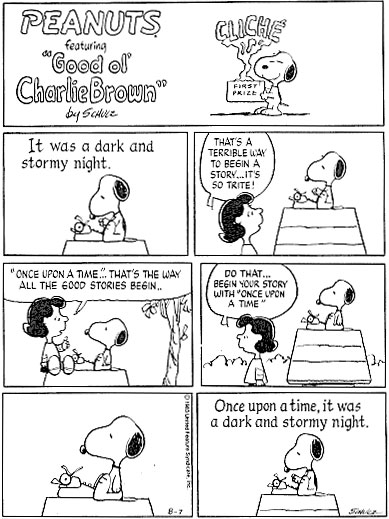
It was a dark and stormy night.

OK. Maybe that last one doesn't leave you with any unanswered questions. However, I LOVED that sentence when I was a child (right up there with "Last night I dreamed I went to Manderly again.")  I remember wishing I could come up with something so simple yet beautiful. What a shock to grow up and find out it is something of a purple-prosy joke. It was first written by Edward Bulwer-Lytton in 1830, and has been used many times since, like here:

Good Omens by: Terry Pratchett and Neil Gaiman:

It wasn't a dark and stormy night. It should have been, but there's the weather for you. For every mad scientist who's had a convenient thunderstorm just on the night his Great Work is complete and lying on the slab, there have been dozens who've sat around aimlessly under the peaceful stars while Igor clocks up the overtime.

And here:


There is also a video of Snoopy's creative process. It's pretty funny, but the only version I could find was not  high quality. It's here, and the first 45 seconds are especially applicable to this blog post.

What's your favorite first sentence? And more importantly, what makes it so great?

Thursday, May 3, 2012

Art project


First of all, guess what? It's my birthday! There are a lot of people out there who don't like to advertise the day, but I've been an attention hog since I was five (there is video proof of this, but thankfully it hasn't been digitized).


Sometimes, I write my posts, I have the desire to draw a diagram, of all the parts of writing you need to make an amazing story. I have about zero ability with visual art, but I envision this diagram as some sort of nebulous atom with electrons, or maybe a fractal. Like so, with tiny parts repeating to make a whole:


Or so:

(from http://singingblackbird.deviantart.com/)

Or maybe one of those cellular diagrams that they show you in upper division biology class. The nucleus is the heart of the story, the DNA is the theme, the RNA is the plot (you know, developing of the theme…)… and um, the characters are…. Well, that's about how much I can recall of cellular structure.

Maybe a fractal is most appropriate. I envision the larger diagram as the story, and as you zoom in, you see plot, character, pacing… and then once you zoom in on those, you see different aspects of character, like physical attributes, character growth, strengths and weaknesses. And so on. Each skill is necessary, though strengths can be used to compensate for weaknesses. The diagram would be opaque, of course, because at the center of any good story is heart, and soul, and no amount of tutorial can teach you that, as it's the most individual aspect of writing.

Once this diagram was complete, there could be a graphic of it, where it zooms in on the section a blog post would be talking about. The selected spot could light up, or sparkle, or do the hokey pokey, or something.

What would you envision as a master story diagram?

Wednesday, May 2, 2012

Fight! Fight! Fight!


There's no doubt about it, learning to craft words so that readers are swept up to another world is hard work. Writers must paint captivating scenes, create believable and sympathetic characters and then have them do amazing things to boot. The real kicker is, everything has to be pictured crystal clear in the reader's mind.

One of the trickiest times I've found to pull it all together is when writing fast moving action sequences - especially fight scenes. So, I thought I'd share a few of my own super secret action scene combat techniques that I picked while trying to figure this out for myself.

Study Up

I should probably read up on the theory of writing action sequences, but you know, for some reason, I haven’t yet. What I have done is picked up a lot of action-y books and read the fight scenes very closely (observation is a great education). Here are a few things I've learned:

  • The build up is just as important as the actual action. The time for inner dialogue, explanations and innuendo is before the characters put up their dukes. The anticipation heightens a reader’s response to a fight scene. (Which, btw, is also probably one reason why starting a story with a major fight scene rarely works. We have no background and no investment in the characters, no matter who they are.)
  • Be extremely concise. Say what you mean, mean what you say. Which is actually really hard. Now is not the time to be flowery.
  • Fight sequences are usually brief. Oh, there might be a few of them stacked together to finish the scene, but they can often be broken down into discreet, manageable pieces.
  • Please silence your inner dialogue during the action scenes. Please don’t do any flashbacks in between karate chops. Don’t wonder why the opponent’s eyes are so blue, or how he got that minuscule scar above his left eyebrow. Save it for after your mc’s knocked him out and he/she has time to look.

How to Write Fight Scenes Step By Step

Okay, this is probably extreme, but sometimes I just get so hung up that I can’t move forward even to do a hold-your-nose rough first pass. This is how I’ve worked through it successfully. And yes, I do realize it’s overkill on thinking-things-through, but this is how I function.


Write up a to-do list sequentially of every little, tiny thing that needs to happen in the scene. For instance, if I was writing this passage from A Conspiracy of Kings (I wish I could write like mwt), my list might look something like this:

  •  Get into the room.
  • Find the sword under the couch.
  • Unsheath the sword.
  • Someone’s coming in.
  • Get up, ready to fight.
  • Kill the enemy.


The study had a door and a window. I jumped through the open window because it was faster and fell to the stone floor on my stomach, scrabbling in the dust under the couch until my hand closed on a stiff leather strap. I dragged the sword free of its sheath with difficulty and turned, still on my knees, as a man filled the doorway. Coming from light into the dark, he was looking ahead of him, not down toward me. My lunge, as I came to my feet, took him in the chest as I drove the sword upward with the strength of my legs. Even rusted, the sword slid through him, and I found, for the first time, how easy it is to kill a man. (A Conspiracy of Kings, p. 8 - Megan Whalen Turner)


Below each bullet item, write one to three short sentences that tell exactly what happens. Here’s how a piece could potentially begin as short sentences using a passage from Graceling:


1She jumped and kicked at his chest. 2He crashed to the ground / and she threw herself on top of him, / struck him in the face once, twice, three times, / and kneed him in the side before 3he was able to throw her off. 4She was on him again like a wildcat, but as / she tried to trap his arms 5he flipped her onto her back / and pinned her with the weight of his body. 6She curled her legs up / and heaved him away, and then 7they were on their feet again, / crouching, circling, striking at each other with hands and feet. 8She kicked at his stomach / and barreled into his chest, / and they were on the ground again. (Graceling, p. 78 – Kristin Cashore)


See if that order makes sense. Switch bullet items around until it does.

Flesh out the short sentences. Either combine them, or add a little more detail etc.


Go back and proof it a final time. Is the action clear? Is it in order? Run it past someone and see where they get confused. Proof it again. Voila, the perfect action scene.

Halfway to the trees an awful sound reached his ears – the hoofbeats of a single horse closing in. Daring a glance back, Alek saw a horseman on the other side of the stream, riding hard. His carbine strap was wound around one arm.

He was ready to fire…

Alek turned away and scrambled up the bank. The rye in the fields was chest high, tall enough to hide in. A shot rang out – a geyser of dirt shot up a meter to his right. He dove into the rye, thrashing away from the stream on hands and knees.

The carbine cracked again, and the bullet sliced past Alek’s ear. His instincts screamed to run farther in, but the horseman would see the tall grass moving. Alek froze where he was, panting. (Leviathan, p. 129 – Scott Westerfeld)


HTH

~Susan

Tuesday, May 1, 2012

How Writing is like Parenting


I wrote my first novel in high school, but I didn’t return to writing until I was pregnant with my second child.  So throughout most of my serious writing (in high school I was just playing) I’ve also been parenting, and I’ve seen a lot of parallels between the two.

Here are a few that I’ve noticed.


It’s harder than it looks

When I was pregnant with my first child, I wasn’t worried about being a parent.  After all, I had tended a lot of kids, watched nieces and nephews grow up, and read the books.  If all that failed, I had my mom who was a baby pro.  How hard can a newborn be after all they sleep all the time? 

Then the baby comes.  And for some reason, newborns can’t sleep.  You think that sleep is so important that it would be to our evolutionary advantage for babies to be able to go to sleep, but they don’t.   Not without constant jiggling and walking around, and once I do finally get them sleeping, the minute I put them down, they wake up.  But the difficulties of parenting do not end there.  There is potty training, disciplining, teaching them to share and get along with others, worrying about them falling behind in school.  All of this is so much harder than I ever anticipated.   

It never ends, and it never gets easy.

Writing is the same way.  I’ve read hundreds of books and watched hundreds of movies.  I was taught basic grammar and composition in school, so writing a novel should be easy.

Only it’s not.  Putting words together to paint images and evoke emotion is so much harder than the pros make it look.  Weaving plot points together and creating believable characters is far more complex than I ever imagined.  And I find myself staring at that blinking curser for hours wondering why it is so hard to express what is in my head.  And I begin to realize that even those writers who I thought were horrible are actually kind of amazing.


Advice is everywhere, but finding the right advice is tricky  

There is a lot of writing advice and parenting advice.  There are books and articles by professionals.  Other struggling parents and aspiring writers offer their two cents as well, and even people without kids or have never tried to write anything beyond a term paper have advice to offer.   Great advice can be found anywhere, but sifting through that advice and finding what actually works for me is challenging.

I’ve noticed that for parenting and writing some of the advice is like gold, a lot of it has to be tweaked, some I can’t figure out how to apply, others while good I just can’t use because it is so contrary to my personality, but very little of it is completely useless.

But figuring out how to apply that advice is tricky.  So many times I read an article and it sounds so clear, but when I try to implement it in my parenting or writing, I realize how complicated it really is.  I’d love to have Super Nanny or an awesome professional writer as a mentor standing over me and helping me to see exactly how to make the advice work, but I don’t.  

So mostly I’m floundering, trying to sift through all the great advice and figuring out how to make it work.


Never stop learning and growing

The thing a miss the most about my life before children was coasting.  When I started something new like a job or college or even marriage, my life was thrown in an upheaval, but eventually I adapted, figured out what I need to do to be successful and then went back to coasting.  There was far more coasting than adapting, and that is what I like.  I only like conflict and tension in books not in real life.


But in parenting, I hardly ever get to coast.  My kids are constantly growing and changing and getting smarter and smarter, and never seem to stop challenging me.  I’ve had to learn to accept a life of constant upheaval and adaption.

Writing is no different.  Every time I think I’ve got this writing thing figured out, I realize I’ve only scratched the surface.  There is so much to learn and different techniques to perfect.  Every story provides new challenges, and I’ve realized I’ll never be done learning.  I’ll never be able to just coast.

And honestly, I think that is kind of awesome.  :)


Comparing myself to others is painful and pointless

There is a mother in every neighbor who seems perfect.  Her house is always spotless, her yard weed-less.  She always looks amazing and so do her kids.  Her children are popular, well-behaved, athletic, talented, and at the top of their class.   The rest of us just stare at her and wonder if her house is in some sort of time warp.  She must have more hours in the day then us mere mortals.

Sometimes other mothers get overly critical and try to tear her down, or they compare themselves to her and feel inadequate and inferior and bad about themselves.  It can make them feel insecure and question all the decisions they’ve made and doubt all their parenting choices.   I hate to admit it, but I’ve been there.  No good comes from all that negativity, just hurt feelings.  It is a waste of time and energy and isn’t going to make you a better mother.

Writing is no different.  There will always be another writer that seems to have it all together.  Writes better than me, writes more than me, reads more than me (coughcoughSheenacough).  But comparing myself to that writer is pointless, a waste of energy that should be put into my writing.  So the best thing to do is to say, “You go girl,” and move on. 


In the end, I gotta be me

This was a hard thing for me to realize as a mother.  I was so used to finding solutions to problems, that I wasn’t ready for problems that have no one right answer or no wrong answers or sometimes no answers at all.   There is no magic formula for parenting.

There is no one in the world exactly like me, and there are no other children that are exactly like mine.  And what works for one parent or a thousand or a million parents won’t necessarily work for me.  In the end of this crazy parenting thing, I have to find my own way.  Become the best mom that I can be with my own distinct values and perspective.  I can’t be the mom in the parenting books.  I can’t be like the perfect mom down the street or my sisters or my mother.  I have to be me, and adapt my parenting style to fit my very awesome and unique children.

Now I’m not saying not to read parenting books or seek parenting advice; that would be foolish.  I’m not so arrogant to think that I don’t have anything to learn.   There is great parenting advice out there that will make me a better parent.  I believe I should learn everything I can, but adapt that knowledge to fit me and my children.  Knowledge is how we develop as parents as people as writers.  But in the end, we have to embrace the part of us that makes us different and turn that difference into our greatest strength.

Writing is the same.  It is important to read and learn about how to write effectively, but in the end I need to use that knowledge to learn how to accentuate my own personal style.  We are all unique, and it is what makes me different that develops that hard to define voice that all agents are looking for, that part that makes every story, even ones that have been told a hundred time before, really unique.  

Writing what I love and the way I want it to be gives my writing authenticity and can really make it shine. So learn all you can about the craft of writing, but in the end develop your own style and embrace who you are, and your story will be amazing.

That’s all I got, but I’d love to hear any of your insights.  What have you learned from parenting or life that is applicable to writing?


~MaryAnn