Showing posts with label ideas. Show all posts

Thursday, October 16, 2014

Learning through Editing

I don't remember exactly why I joined Hatrack. I think it was because I had a story to send out, and I had the vague impression that I should get feedback on it in order to help myself get published. And I picked Hatrack because Orson Scott Card ('nuff said). But that turned out to be the single smartest decision I made for my development as a writer, because it introduced me to a wonderful community of writers – and because it taught me how much you can learn by editing/reading someone else's work.

Specifically, though, I want to talk about the type of editing that puts me on the other side of the writer/publisher relationship – my time as a Managing Editor at Flash Fiction Online. It constantly amazes me how much I learn from reading, and from the discussions our staff has about what stories to publish. That time – known as winnowing – is everyone's favorite. We argue. We cajole. We learn how to present detailed arguments to support why a story should be published.

And so, here are some of the main things I've learned from being an editor. None of these are particularly mind-blowing. So maybe I should say, here are some of the common pieces of advice that editing has helped me to understand the rationale behind them.

1. Pretty words are not a story

This is the newest, and one of the hardest things I've had to learn. Some of my favorite books (Heart of Darkness, The Last Unicorn, everything by Patricia McKillip) have gorgeous, lyrical prose. But increasingly I find myself frustrated at the word salad I have to slog through in order to get to the heart of a story. I still love imagery and pretty language, but sometimes I wish people would put away the thesaurus and tell the story in simple, plain terms.

In my own writing, I'm still trying to figure out the line. I don't think I'm going to stop using imagery, but I'm certainly going to be more ruthless about how much I let myself keep in the final drafts.

2. Emotional honesty is a rare and precious thing

One of my slushers has been complaining lately about the number of stories featuring difficult situations faced by wide-eyed children. It's something we see often – where the writer has gone for the biggest emotional punch possible. Sort of like, "It'd be sad if the main character had cancer, but it would be EVEN SADDER if he got the cancer while rescuing puppies from communists!" (You see this type of thing in anime all the time too – all the characters have to have a horrifically tragic backstory). The instinct is understandable. Emotion is what attaches us to the stories we read. However, I'm beginning to think that it's not the amount of the emotion that matters. Rather, it's the truth of that emotion, and how well the writer projects it.

This one is harder to apply to my own writing. As it is, I worry I have something of a tendency toward melodrama. I think it also has to do with the delicate balance between showing, and making sure the emotion comes across.

3. There are no new ideas – and that's okay

We see patterns of stories. Sometimes it's more obvious where they come from – I think it was about a year ago that someone must have had a Red Riding Hood anthology. I got very tired of those stories quickly. There are other phases that have less obvious of a rationale. I'm very glad we are out of the 'Husband randomly kills nagging wife' or vice-versa phase. Right now, serial killers are more popular than ever. And don't talk to me about second person POV.

The problem is, it's hard to set hard and firm rules about what stories or trends I hate. Because every time I do so, someone comes along with an exception to the rule, and I have to shut my mouth all over again. In my opinion, what separates out the good stories from the thousands of similar ones is connected to #2: emotional honesty. Sheer originality is a good thing too, but an old idea well-told can be a glorious thing.

This is the easiest one to follow: write what you want, as long as you believe in it.

Thursday, May 31, 2012

Rationalizing magic


I've been thinking a lot lately about how I write stories, and how my methods might be causing me some difficulty.

As I've mentioned before, ideas are the easiest for me. However, they come in bits and fragments, rather than whole story ideas.  For example, I imagined a girl tripping and falling through shadow into another dimension. Marbles that hold bits of memories and music. A society where the young people never see summer, because of a plague that happens only then. And an area so contaminated that no magic can exist there.

The problem I have is making those bits of ideas work in the context of a whole story... and a logical worldview.  I can get so frustrated with the rationalizing process that my interest in the story wanes.

Let's take the example of the place so contaminated that no magic works there. I liked the idea of there being sites around the world where no magic can exist. I've been reading about several case studies - Fukushima is always in the news. And about Japan's Minamata Disease, caused by years of chemical factories spilling tons and tons of organic methylmercury into the ocean, leaving thousands of people with nerve damage and developmental disorders (note: do not google Minamata Disease, especially pictures, if you have a weak stomach or want to be able to sleep  tonight.  I'm referring to descriptions of effects on children and a few horrifying photos).  Fukushima, of course, is always in the news.  And, of course, Chernobyl (last year, I read Voices from Chernobyl, made up entirely interviews with survivors. It's one of the most amazing and heartbreaking works I've ever read).

An abandoned grand piano in Pripyat. Photo attribution Timm Suess, from Wikimedia Commons.

So it all seems great - poison, toxins and radiation disrupt magic. But how? The scientist in me wants to know, the reader in me hates when things don't make sense.  Never mind having no idea how toxic metals might interact with magic, I don't know enough about physics to explain how radioactive iodine and other particles might interfere with whatever energy defines magic. In the current short story I'm working on, I don't go into it too much, except to state that magic comes from the energy of all living things, so anything that disrupts or corrupts that flow of energy corrupts magic.

So how about you? As a reader, how much logic do you expect from magic systems? Do odd magic systems and ideas bother you in a novel or short story if they're not properly explained?

And how do you, as writers, handle ideas that seem cool but don't make immediate logical sense? How do you explain them without getting frustrated?

Friday, March 16, 2012

Find the real story beneath your BIG IDEA

Are you putting the finishing touches on your dystopian YA novel about kids who are chosen by lottery to fight to the death on national television? If so, this post is for you.

MaryAnn’s enlightening post on emotional resonance has had me pondering what else poetry can teach us about story. A few years ago, I had the pleasure of attending a poetry workshop with Richard Jones and subsequently falling in love with his collected poems in The Blessing. He talked about where he got his ideas, and how everyday things can inspire poems like The Altar, about the joys of sharpening a pencil. But he also said that some themes come up again and again, such as the tragic death of his young nephew. His analysis of whether this was a problem, which I'm paraphrasing from patchy memory, was something along the lines of: So what? Mary Oliver's been writing the same poem for thirty years.

If you’ve read much Mary Oliver you’ll know why everyone laughed. You’ll also know she’s one of the most universally loved poets of the last few decades. 

To say that reading one Mary Oliver poem is like reading them all would be like saying that every time you hug your child is exactly the same as every other. Of course it isn’t. He grows and changes and sometimes he hugs hard and sometimes he hugs soft, and sometimes he asks in a whisper if reindeers get Christmas presents and sometimes he tells you I love you the best of all, Mommy, except also I love Daddy the same because I don’t want to hurt his feelings.

You wouldn’t ever not want another hug, just because you’d had hugs before.

Storytellers seem to diverge from poets here. No one wants to reinvent the wheel, or more pessimistically, beat a dead horse. (Even worse: a flesh-eating horse that won't die.)

The speculative fiction magazine Strange Horizons publishes two laugh-out-loud lists of dead horses: Stories We've Seen Too Often and Horror stories We've Seen Too Often

When I'd finally caught my breath again after imagining the horrors of being a slush reader for Strange Horizons, I noticed that star-crossed lovers, man vs. nature, kidnap & rescue, and any others of the 1, 3, 7, 20, 36 or 42* basic plots were not on these lists. Maybe that’s because it’s a speculative fiction magazine, but my money is on the fact that classic plots don't hinge on clever world-building or twist endings.  They are frameworks for universal experience and emotion.

Some authors do amplify their stories with fascinating new ideas, which is exciting. It’s also rare. And relying on originality to sell a story is risky; someone else may have had the light bulb go off just before you did. 

When I think about what makes poetry work, I realize that a unique premise is overrated.  I think this is true even in that skeleton of the literary closet called genre fiction. 

My current, never-ending work-in-progress has vampire characters. Sometimes I wish I had a 12-step meetings for vampire writers where I could publicly admit I write them and everyone would nod and welcome me and we’d all drink weak coffee in styrofoam cups. 

I guess I’ll just admit it online and make my own coffee.

This novel was never supposed to be about vampires. Supernatural undead aren’t the point of the story. Fear, love, courage, family, finding your way out of a rock and a hard place… those are the point of the story. I could change the vampires to some other ambiguous evil, or even take out the supernatural altogether, and I may someday. Paranormal stuff is fun to write, but the premise is not the story.

Most of the items on the Strange Horizons lists are ideas where the premise is the story. For instance, #12 on the Horror List:
Initiate into religion discovers that the religion is actually killing/destroying its initiates.
Before we continue, I must review the warning from the fiction list:
One more thing: We know it's tempting to look at this list as a challenge. Please don't. In particular, please don't send us stories that intentionally incorporate one or more of these items.
In other words, don't try this exercise at home. And if you do, don’t send it to Strange Horizons.

Back to business: I don’t know that this plot isn’t salvageable. Maybe it is, maybe it isn’t. But I do know that if the whole story is just building up to this horrifying revelation, you will never meet the challenge that you were already advised not to take but we’re hypothetically taking anyway.

Let’s say you already started this story, and now you stumble across this list and bang your head on your desk. You declare you’re done with fiction forever because you’re a writer, and prone to histrionics.

There’s a good chance you initially approached your story with the time-honored question: What if? Perhaps: What if a religion’s sole purpose in recruiting new initiates was to kill them? You were very proud of your idea until you read that website, or this post.

I say the game isn’t over! Maybe, just maybe, the premise isn’t your problem. Maybe it’s the question. 
What if? is a great question. I support what-iffing. But if you think your story has already been written, you might need to ask, What would it feel like?

What emotional state makes a person vulnerable to a predatory cult in the first place? How does it feel to find acceptance? What does it feel like to have your sense of meaning—of purpose, of life and death, of God—crumble under the weight of betrayal? How do you find the will to fight?

When a timid voice of intuition tells you something is wrong, what does the air feel like on your skin? What do you smell? What seeps through the filter of your senses?

These aren’t light questions. These are heavy questions. Some of them are questions that poetry asks all the time. Poems grapple with love, friendship, grief, loss, meaning, death… They tackle these over and over and over again, and yet poetry has never been exhausted. 

Neither have stories.

Whether you’ve written The Hunger Games, Twilight, or murderous cult story #12, don’t despair. Figure out what your story is really about—not the cool what if idea, but the story underneath. The what would that feel like? story. That's the story that only you can write, and when you find it, the rest is fixable. I think.

And if you lose your way, read some Mary Oliver. That same poem she’s been writing over and over? It never gets old.

But little by little,
as you left their voices behind,
the stars began to burn
through the sheets of clouds,
and there was a new voice
which you slowly
recognized as your own…
                                               From "The Journey"; Dream Work 

Whoever you are, no matter how lonely,
the world offers itself to your imagination,
calls to you like the wild geese, harsh and exciting —
over and over announcing your place
in the family of things.
                                                From "Wild Geese"; Dream Work

*Okay I made up that last number. It just seems like there should be 42 basic plots.

Thursday, February 23, 2012

Idea Hunting


There are many things in writing that I struggle with: characterization, writing stories shorter than 10,000 words, pacing (dear god, pacing)….  But one thing that has always come easily to me: ideas.

In a magical, perfect world, ideas would rain from the sky, or grow on trees.  That hasn't quite happened to me, but back when I started writing seriously, I'd have crazy, full story-length dreams. For a new writer, it was extremely convenient.  But there were two problems:

1) Even the most perfect dream story was not entirely flush with logic, and some of the more bizarre (and cool) occurrences took too much time to explain within the story.
2) A few years later, I stopped having those sorts of dreams.

I'm actually not all that upset.  The dream stories were in general to be more trouble than they're worth. So I've had to adjust.  Lots of authors like to say that they find inspiration everywhere, throughout their everyday lives. That has certainly happened for me... but it just seems to take way too long. So instead of waiting for ideas to come to me, I've learned to go out hunting for them.

My current favorite source is writing prompts. Prompts tend to range from a simple concept (such as that anthology Dark Faith I was writing for, to detailed descriptions of plots or even worlds.  The ones that work best for me are the ones that provide multiple seemingly unrelated objects or concepts that I can combine as I wish. 

Pictures can be another of my favorite sources of inspiration. The journal With Painted Words has a monthly contest where each story must be inspired by the month's picture. But that's the only journal I know of. One of my other favorite sources for pictures is Wikimedia Commons and their annual featured photo contest (here are the 2010 winners). 

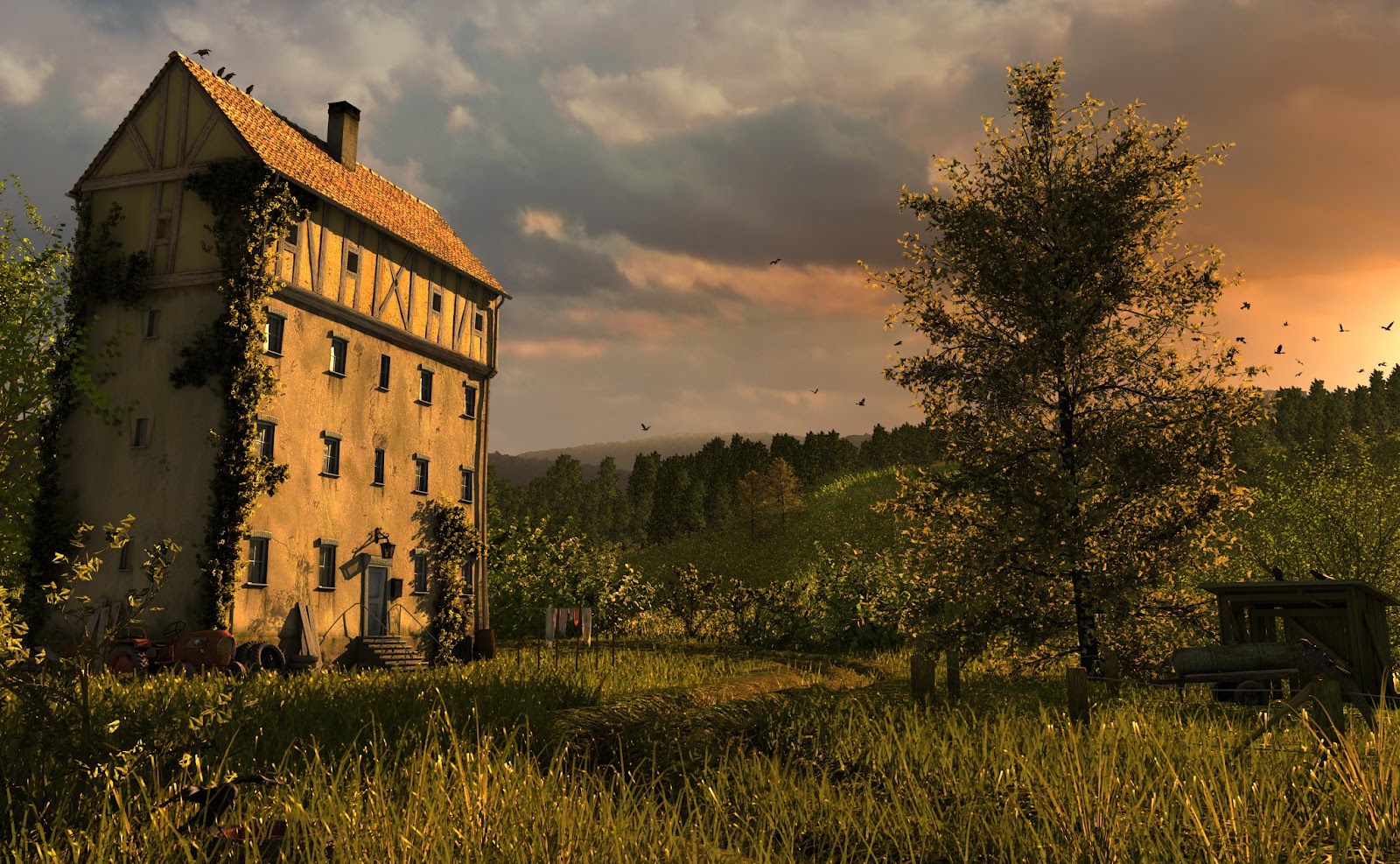
For example, the following picture pretty much demands its own story. (click for larger size)
photo by Mayquel, from wikimedia commons

It looks abandoned, so whose laundry is that? And why do the top floors look like a separate house, like it once sat at ground level, until the lower floors rose from the dirt, pushing the old house up closer to the sky?

Once I find a prompt, I sit down at the computer and pour every thought I have onto paper, until I find an interesting one (like a house rising slowly from the ground, still brown with dirt - why would that happen? Fairies? Aliens? House is alive? It's a reflection of someone's subconscious?)

As another example, the Liberty Hall Flash Challenge (link below) once had this as their prompt.

Cazadora de Astros, by Remedios Varo

I got a poorly written flash story out of the challenge, but the idea from that challenge keeps growing and changing, and now it's slated to be my next novel.  (Melanie, I think you read it when it was a novella - this is "Swallowed the Moon" I'm talking about, in case you remember). 

As a bonus, Remedios Varo is now my favorite artist (she's a surrealist, a contemporary of Salvador Dali).  Basically every single one of her paintings is a story.  Here's a page with a bunch of her works, or you can do a Google image search to see her many, many gorgeous paintings.

Not every prompt leads to a novel.  But one of the things I've found about writing is that pretty much every aspect of it takes lots and lots of practice.  The same is true with hunting down ideas - I have pages and pages of half-finished prompts and really terrible ideas.  But the more I practice, the faster I come up with ideas, and the easier it is to identify the great ones.


 Here are some links to good sources of prompts. There are far more out there than I have space to include.

  • Hatrack River's Writers Workshop has a contest section (run by its members; anyone can start a contest).
  • Liberty Hall Writer's Forum runs weekly flash challenges and short story challenges.  You email them for the prompt each week - and if you're just gathering ideas, like me, you're not required to enter.
  • Polluto has some of the most detailed prompts I've ever seen.
  • Penumbra has monthly themed issues.
  • I like the idea of the Ancient New Anthology, where they ask you to present a society that has one invention way ahead of its time (I wanted to do a medieval society with genetic testing, but then I started to wonder how they would get the energy to run the equipment, and if that counted as two technologies, or if I could make that stuff up, and could you really do it without computers, and then I had a headache and had to go lie down).
  • With Painted Words has a new picture each month as a prompt.
  • This anthology has a cool picture as a prompt.

Happy idea hunting.


Saturday, December 17, 2011

There Must be a Story Behind the Story

Once upon a time, a woman whose dark brown hair was streaked with gray stood in a pool of water. She wore damp capri jeans rolled up over her knees. Next to her, a great, green frog hunched in the water, its mouth open wide. The woman peered into the frog's cavernous mouth in some consternation. After several moments, she leaned forward and stuck her head inside. "Are you coming?" she asked. Her voice echoed, but no one answered her.


 Quickly, the woman splashed around the frog. Where the frog's back should have been, there was an empty set of stairs. Whirling around, the woman caught sight of a tiny pair of wet footprints leading toward another pool. "Not again!" she muttered and pulled herself out of the pool onto the rough concrete sidewalk.

She didn't need to follow the footprints to know where they went. She ran to the round kiddie pool with the whale and the turtle. Her three year old boy was already trying to climb onto the turtle's back. "You're a quick one," she said, and stepped into the cool pool. Already both sets of footprints were fading in the heat.

Day after day, the woman and the boy came to the pools. The average observer might have thought they were merely waiting for her other children while they took swimming lessons at the big pool. Though that was partially true, something much larger was going on, something that would eventually change that woman's life. She was turning into an author.

 The conditions were perfect for such a transformation. A beautiful spot with lots of sensory stimulation. The need for her brain to stay alert, but with plenty of downtime And a question...

 WHY? 

 That's the question that transforms me from your average ordinary woman into a super-being capable of creating whole worlds inside my mind. Why would a character interesting enough to be the main character of a novel be standing in a kiddie pool? 

 Obviously she's a fairy with an affinity for water.

 Well yes, but why is she here? In this place? 

She's, um...helping a friend, yeah. Taking her friend's daughter to swimming lessons. This place is great and everything, but it's obviously not magical.

Why is she here at all? 

Hmmm....maybe she's trapped on Earth, and she got a job taking care of an elderly woman. Yeah! And she's falling in love with the woman's grandson, and this is his sister's daughter. Yeah. 

Why is she on Earth? 

 Ooh. Good question, and I'm glad you asked. Because she was being hunted for her particularly strong magic on her own world. Once she got here, someone closed the gates between the worlds, and now she is trapped.


Why is she so sad? 

 And so on...day after day. By the time I noticed what was happening, I'd already been daydreaming about it for weeks. I backtracked so far that the book I wrote was all about Jenny's time in her own world, not on Earth. If I ever write a sequel, however, this scene will be in it, for sure.

 It won't be a major scene of course. In fact, it may only be there for sentimental purposes. (Yes, I know, I know, kill your darlings. But surely, there will be a way for me to work in the setting at least. Only time will tell.)


 Nearly every story I have ever created began with me outdoors, doing a physically repetitive activity. Last summer, I took up jogging. The place where I live has a lot of hills, so, being an inherently lazy person, I like to jog on the nice, flat track. It can get boring though, so I asked myself why a character interesting enough to be in a novel would run in circles day after day. I discovered a girl named Amye, living in the dungeon of a castle in a fantasy world. Luckily for Amye, this was a relatively humane dungeon, and the prisoners are allowed two hours of exercise time in an enclosed courtyard every day. She has discovered a plot to escape, and she spends her time running around the courtyard trying to prove she is strong enough to be included. Whenever Stephen, another prisoner, passes her, he trips her and sends her sprawling. Again I had to head backwards through the maze of story ideas...Why is she there? Why is Stephen treating her like that? The answers turned out to be very interesting. And so another book was born.

WHY are you telling us this, Melanie? 

 My way of imagining a random scene and using it to create a whole world is probably not the method you use to create a story, and I wonder if we could learn from each other. It's good to find many pathways to creativity.

 My particular method works well for creating strong characters and rich worlds. It's not usually so great at helping me with story arcs, and that's something I really struggle with. So tell me:

Where do your story ideas come from?